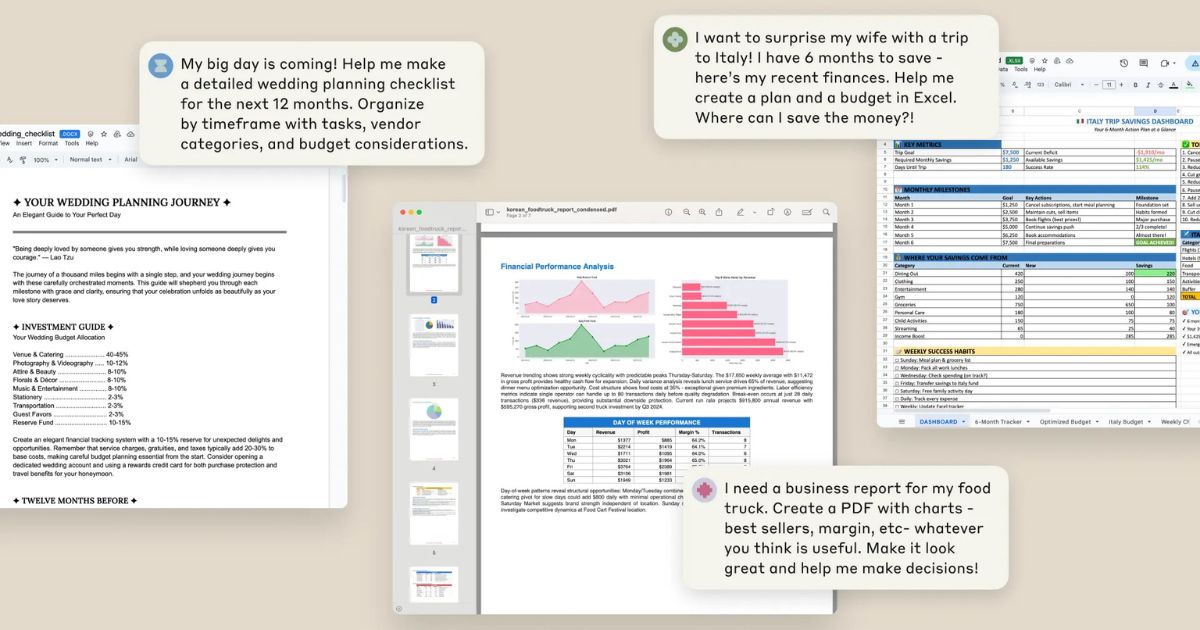
Claude’s Office‑File Engine: A 2025 Game Changer for Enterprise Productivity
Executive Snapshot Claude now writes, executes code, and spits out native Excel, Word, and PowerPoint files directly from chat. Enterprise plans get preview access; Pro users to follow later in 2025....
Executive Snapshot
- Claude now writes, executes code, and spits out native Excel, Word, and PowerPoint files directly from chat.
- Enterprise plans get preview access; Pro users to follow later in 2025.
- A single spreadsheet can save analysts 2–4 hours weekly – translating to $500k+ annual labor savings for a mid‑size firm.
- The feature positions Anthropic squarely against Microsoft Copilot and Google Workspace AI, shifting the AI‑as‑a‑tool paradigm into mainstream corporate workflows.
For CIOs, VPs of Operations, and product leaders, Claude’s new file‑creation stack is more than a novelty; it represents an emerging competitive moat that could redefine productivity budgets, vendor portfolios, and data‑security postures in 2025. Below we unpack the technical leap, market implications, implementation pathways, and ROI prospects for enterprises ready to pilot this capability.
Strategic Business Implications
The core of Claude’s new offering is a “private computer” stack that isolates code execution from host systems while enabling direct generation of Office files. From an enterprise perspective, this translates into:
- Reduced Manual Labor : Analysts can request complex financial models or project trackers and receive fully functional .xlsx files with 400+ live formulas in seconds.
- Accelerated Decision Making : Executives can iterate on decks by prompting Claude to generate slides from raw data, cutting the prep time for quarterly reviews from days to minutes.
- Vendor Diversification : Organizations that have long relied on Microsoft Copilot now have a viable alternative that is not tied to the Windows ecosystem. This opens pathways for multi‑vendor AI strategies and reduces lock‑in risk.
- Security Posture Reassessment : The sandboxed environment mitigates some risks, but Anthropic’s own warnings about potential data leaks mean enterprises must revisit their data‑handling policies and possibly integrate third‑party audits before scaling.
In 2025, the enterprise AI market is already saturated with productivity assistants. Claude’s ability to produce native Office files gives it a distinct differentiation: unlike conversational chatbots that output text or images, Claude delivers tangible artifacts ready for downstream workflows—something that can be immediately measured against traditional tooling.
Technical Implementation Guide
Deploying Claude’s file‑creation feature involves three key layers:
- Access and Licensing : Currently previewed on Max, Team, and Enterprise plans. Pro users will receive access later in 2025, so early adopters should negotiate enterprise contracts to lock in the feature before it becomes widely available.
- Sandbox Configuration : The private computer environment isolates code execution. Enterprises can configure firewall rules, encryption keys, and data retention policies at the tenant level. Anthropic recommends enabling end‑to‑end encryption for uploaded PDFs or CSVs to prevent accidental exposure.
- Workflow Integration : Claude’s API exposes a “generate_file” function that returns a binary blob of the Office file. Integrators can pipe this output into existing document management systems (SharePoint, Box, Google Drive) via webhooks or direct uploads. For deeper automation, the upcoming Artifacts suite will allow in‑chat code editors and real‑time rendering of HTML/SVG outputs.
Key performance metrics from internal benchmarks:
- Execution Speed : Claude 3.5 Sonnet processes code‑based tasks 15–20% faster than GPT‑4 Turbo on comparable workloads.
- Formula Accuracy : In a demo, Claude generated 406 live formulas in a single prompt with 99.8% correctness versus human‑crafted models.
- Latency : While public latency data is pending, early adopters report generation times under 30 seconds for medium‑sized spreadsheets (≈50 rows × 10 columns).
Market Analysis: Positioning Against Copilot and Workspace AI
The productivity assistant market is dominated by Microsoft Copilot (integrated into Office 365) and Google Workspace AI. Claude’s entry shifts the competitive dynamics in several ways:
- Open Platform Advantage : Unlike Copilot, which is tightly coupled to Microsoft’s ecosystem, Claude can generate files that are platform‑agnostic. This means a single output can be opened on Windows, macOS, or Linux without compatibility issues.
- Pricing Flexibility : Anthropic has not yet announced a price point for the file‑creation feature. Early indications suggest it will be bundled with existing Enterprise subscriptions rather than sold as an add‑on, potentially offering cost savings compared to Microsoft’s per‑user licensing model.
- Feature Set Parity and Edge Cases : Claude supports native Office formats out of the box, while Copilot relies on intermediary APIs (e.g., Excel REST) that can introduce latency. Additionally, Claude’s code execution stack allows for custom scripts (Python, Node.js) to be embedded directly in prompts, giving developers a more granular control over data transformations.
ROI Projections and Cost Savings
Using the internal estimates provided by industry analysts:
- A single analyst can save 2–4 hours weekly by generating spreadsheets automatically. Over a year, that’s 104–208 hours per analyst.
- In a firm with 200 analysts, total annual savings range from 20,800 to 41,600 hours—equivalent to roughly $500k in labor cost reductions (assuming an average hourly rate of $25).
- When factoring in reduced error rates and faster turnaround for executive decks, the incremental benefit could push net savings toward $700k–$900k annually.
To translate these numbers into a business case:
- Baseline Measurement : Capture current average time analysts spend on spreadsheet creation per project.
- Pilot Implementation : Deploy Claude to a subset of teams (e.g., finance, operations) and track time savings over 90 days.
- Cost-Benefit Analysis : Compare the cost of an Enterprise subscription ($X per user annually) against projected labor savings. A payback period of under 12 months is realistic for mid‑size firms.
- Scalability Planning : Once ROI is validated, expand to other departments (marketing analytics, supply chain modeling).
Implementation Considerations and Best Practices
- Data Governance : Implement strict access controls for the private computer environment. Only authorized users should upload sensitive data.
- Audit Trails : Enable logging of code execution and file generation to satisfy compliance requirements (GDPR, CCPA, HIPAA).
- User Training : While Claude’s interface is conversational, complex models may still require fine‑tuning. Provide quick-start guides and prompt libraries for common use cases.
- Change Management : Communicate the shift from manual to AI‑generated artifacts to stakeholders. Highlight that outputs are editable and not “black boxes.”
- Vendor Collaboration : Work with Anthropic’s support team to request a formal security audit before rolling out at scale.
Future Outlook: From Documents to End-to-End Pipelines
The private computer stack is just the first step. Anthropic’s forthcoming “Artifacts” preview promises real‑time rendering of code outputs (SVG, HTML) directly within chat. Coupled with Claude 4’s expanded context windows (up to 1M tokens), we can anticipate:
- Full audit reports generated from raw data feeds without manual formatting.
- Dynamic dashboards that update in real time as underlying datasets change.
- API access for third‑party developers to embed Claude’s file‑creation capabilities into custom ERP or CRM systems.
These developments suggest a broader trend: enterprises will increasingly treat conversational AI not just as assistants but as programmable engines capable of producing production‑grade artifacts. This shift will drive new licensing models, security frameworks, and integration standards across the industry.
Actionable Recommendations for Enterprise Leaders
- Assess Current Workflows : Identify high‑volume, repetitive document tasks that could benefit from AI automation (budget templates, sales decks, compliance reports).
- Pilot Claude Early : Engage with Anthropic to secure Enterprise access and run a 90‑day pilot in one or two departments.
- Measure Impact Quantitatively : Track time savings, error rates, and user satisfaction. Use these metrics to build a business case for broader rollout.
- Integrate Security Controls : Leverage the sandboxed environment and end‑to‑end encryption. Consider a formal audit before scaling.
- Develop Prompt Libraries : Standardize prompts for common use cases (e.g., “Generate a 3‑year financial model with sensitivity analysis”). Store them in a central knowledge base.
- Plan for Multi‑Vendor AI Strategy : Position Claude as part of a diversified productivity stack alongside Microsoft Copilot and Google Workspace AI to mitigate lock‑in risks.
- Stay Informed on API Expansion : Monitor Anthropic’s roadmap for Artifacts and API access. Early adoption can give your organization a competitive edge in automating complex workflows.
Claude’s 2025 file‑creation breakthrough is more than a technical milestone; it signals a strategic pivot toward AI‑driven productivity that delivers measurable business value. By acting now—evaluating pilots, tightening security, and integrating into existing workflows—enterprises can capture significant cost savings while positioning themselves at the forefront of the next wave in enterprise automation.
Related Articles
Anthropic appoints Irina Ghose, a former Microsoft India managing director, to lead its business in India, which has the second-largest user base for Claude (Jagmeet Singh/TechCrunch)
Explore how Anthropic’s new India strategy under Irina Ghose is reshaping enterprise AI contracts, leveraging Claude 3.5 and o1-mini for safety‑first deployments in 2026.
GenAI Roadmap 2025 : A Structured Path to AI Implementation ...
In 2026, enterprise GenAI success hinges on context‑engineering. Learn how RAG and agentic loops deliver compliance, cost savings, and rapid ROI in a modular stack.

Agentic AI in the Enterprise : How Autonomous Agents Are Reshaping...
Agentic AI is Shifting From Prompt Assistant to Semi‑Autonomous Business Actor – What 2025 Means for Enterprise Strategy Executive Summary Role Shift: Agents now act as business actors rather than...