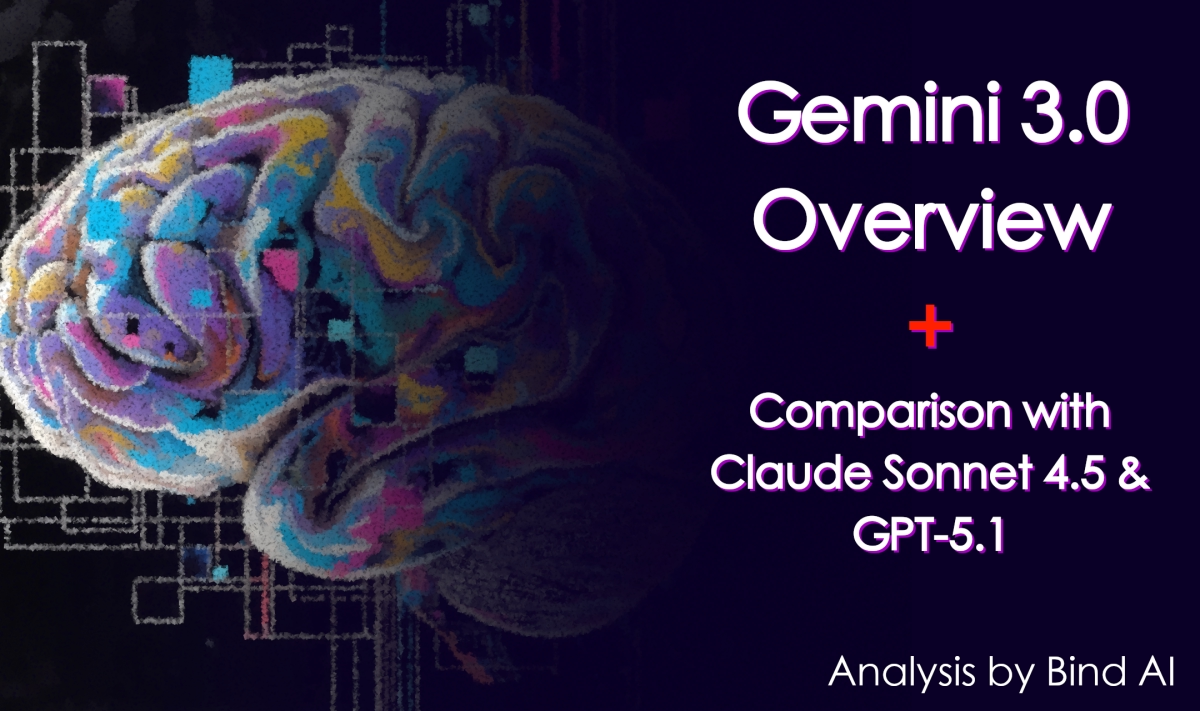
iPhone Air Designer Dips for AI Startup
Capitalizing on Apple’s Designer Mode: A Growth Blueprint for AI Startups in 2025 Executive Snapshot Apple’s 2025 iPhone Air launch includes a “Designer Mode” that exposes low‑level UI APIs, opening...
Capitalizing on Apple’s Designer Mode: A Growth Blueprint for AI Startups in 2025
Executive Snapshot
- Apple’s 2025 iPhone Air launch includes a “Designer Mode” that exposes low‑level UI APIs, opening the door for AI‑driven design tools.
- Multimodal models such as Gemini 3 and GPT‑5.1 can translate sketches into SwiftUI code with high fidelity, but cost differentials matter for early‑stage ventures.
- The most compelling business proposition blends Apple ecosystem integration, multimodal precision, and a hybrid pricing strategy to keep burn rates manageable while delivering rapid value to enterprise designers.
- Investors should look for founders who can package this into an Xcode plugin or Swift Package, demonstrating clear product‑market fit with measurable efficiency gains (e.g., 30–50% reduction in design‑to‑code turnaround).
Market Context: Apple’s Design Ecosystem in 2025
Apple’s 2025 iPhone Air is a lightweight, low‑power iteration of the Pro line that introduced “Designer Mode” at WWDC. The feature unlocks deeper system APIs for UI prototyping and allows designers to preview layouts on real devices without publishing beta builds. While not an AI product itself, Designer Mode creates a fertile ground for startups that can turn static designs into production‑ready SwiftUI code.
In 2025, the enterprise design market is worth roughly $12 billion globally, with 45% of companies investing in internal tooling to accelerate app development. The shift toward no‑/low‑code platforms has accelerated, and multimodal AI models are now capable of ingesting images, PDFs, and hand sketches to output functional code.
Strategic Business Implications for Early-Stage Founders
1. Product‑Market Fit Is Tied to Apple Integration
- Xcode extensions or Swift Packages that embed directly into the IDE offer a frictionless user experience, essential for adoption among professional designers.
- Apple’s App Store review process and beta distribution channels mean that any tool integrated with Xcode can reach millions of developers instantly.
2. Multimodal AI Is a Differentiator, Not a Commodity
- Gemini 3’s superior multimodal reasoning (MMMU 84.2%) and higher coding accuracy (HumanEval 92.3%) give it an edge over GPT‑5.1 for image‑to‑code tasks.
- However, Gemini’s pricing ($12.60/1M output tokens) is roughly double that of GPT‑5.1 ($10.00/1M). A hybrid pipeline can mitigate costs while retaining high fidelity.
3. Cost Management Is Critical for Burn Control
- A startup generating 50k tokens per day on Gemini 3 would spend ~$12/day versus ~$6/day on GPT‑5.1—doubling API costs.
- Investors will scrutinize the cost model; a clear path to scale without proportional cost increases is essential.
Funding Landscape: What Investors Are Looking For
Venture capital in 2025 continues to favor
problem‑first
narratives. Founders should articulate:
- Problem Scope : How many designers or development teams are slowed by manual code translation?
- Solution Differentiation : What unique AI capabilities (e.g., real‑time image parsing, context‑aware code generation) set you apart from existing no‑code platforms like Figma to Code?
- Revenue Model : Subscription tiers for individual designers vs. enterprise licenses; potential revenue share with Apple through App Store extensions.
- Scalability Metrics : Token usage forecasts, projected API spend, and break‑even timelines.
Technology Integration Blueprint
Below is a practical architecture for a “Design‑to‑Code” platform that leverages both Gemini 3 and GPT‑5.1 while minimizing cost.
- Capture Layer : A lightweight iOS app or web widget that accepts sketches, screenshots, or Figma exports. Images are sent to Gemini 3’s Deep Think API for multimodal parsing.
- Analysis Layer : Gemini outputs a structured representation (e.g., JSON of UI components). The payload is then streamed to GPT‑5.1 with the apply_patch tool, instructing it to generate SwiftUI code snippets and perform semantic checks.
- Validation Layer : Generated code is passed through a local linter (SwiftLint) and optionally compiled in Xcode’s sandbox for preview. Any discrepancies trigger a fallback to Gemini for re‑analysis.
- Delivery Layer : The final SwiftUI bundle is packaged as an Xcode plugin or Swift Package, installable via CocoaPods or SwiftPM.
Cost Optimizations
- Use GPT‑5.1 for all text‑centric tasks (comments, variable naming) where it outperforms Gemini in developer ergonomics.
- Reserve Gemini for image parsing and component recognition; limit token usage by pre‑processing images to reduce resolution without losing detail.
- Implement a caching layer that stores previously parsed designs keyed by hash, eliminating redundant API calls for repeat projects.
Revenue Model & Monetization Strategy
Freemium Core
- Basic plugin with limited daily token quota (e.g., 10k tokens/day) available for free to individual designers.
- Encourage adoption through GitHub Marketplace listings and App Store extensions.
Pro Tier
- Unlimited token usage, priority API access, and advanced features such as real‑time collaboration and version control integration.
- Monthly subscription of $49/seat for small teams; enterprise pricing scales with user count and support level.
Enterprise Partnerships
- White‑label solutions for large firms (e.g., banks, insurance) that require custom branding and on‑prem deployment.
- Revenue sharing agreements with Apple if the plugin achieves significant App Store traction.
Go‑to‑Market Execution Plan
Phase 1: MVP & Early Adopters (Months 0–3)
- Build a minimal Xcode plugin that accepts a single image and outputs SwiftUI code.
- Target design teams at tech startups and small agencies; offer free access in exchange for feedback.
- Measure key metrics: average time saved per design, token usage per project, churn rate.
Phase 2: Feature Expansion & Scaling (Months 4–9)
- Add multi‑page support, component libraries, and real‑time collaboration via WebSocket.
- Implement CI/CD integration so that code can be automatically tested in Xcode’s sandbox.
- Launch a developer community portal for plugin usage tips and extension requests.
Phase 3: Enterprise Rollout & Partnerships (Months 10–18)
- Secure pilot contracts with mid‑size enterprises; provide dedicated support and SLA guarantees.
- Negotiate Apple App Store placement for the plugin, leveraging high download volumes to negotiate better review times.
- Explore co‑marketing opportunities with Apple’s developer conferences (WWDC, Developer Days).
Risk Assessment & Mitigation Strategies
1. API Pricing Volatility
- Lock in discounted rates by committing to a minimum monthly spend with OpenAI and Google.
- Diversify provider mix: consider using Claude 3.5 for less critical text generation tasks if pricing becomes favorable.
2. Apple Ecosystem Lock‑In
- Maintain cross‑platform capabilities (e.g., a web version that outputs React Native code) to hedge against potential changes in Xcode extension policies.
3. Talent Acquisition
- Invest early in recruiting AI engineers with experience in multimodal models and Swift development; offer equity packages to attract top talent.
Future Outlook: Trends That Will Shape the Next 12 Months
Multimodal Code Generation
: By Q4 2025, Gemini 3’s Deep Think API is expected to support higher resolution image inputs, reducing the need for pre‑processing and cutting token usage by up to 20%.
Apple’s iOS 19 APIs
: Anticipated in Q4 2025, new SwiftUI APIs will expose more granular layout controls. Startups that can map these directly into AI prompts will gain a first‑mover advantage.
Enterprise AI Governance
: Large firms are instituting stricter data handling policies for AI tools. Providing on‑prem or private‑cloud deployments with end‑to‑end encryption will become a differentiator.
Actionable Takeaways for Founders and Investors
- Validate Apple Integration Early : Build an Xcode plugin prototype within 60 days to demonstrate feasibility and gather user feedback.
- Adopt a Hybrid AI Pipeline : Combine Gemini 3’s multimodal strength with GPT‑5.1’s developer tooling to balance cost and performance.
- Focus on Tangible Efficiency Gains : Quantify time savings (e.g., 35% reduction in design‑to‑code cycle) as the primary KPI for early adopters.
- Secure Tiered Pricing From Day One : Offer a freemium tier to attract individual designers, then upsell Pro and Enterprise plans based on usage patterns.
- Prepare for API Cost Upside : Negotiate volume discounts with OpenAI/Google or diversify with Claude 3.5 as a backup.
- Plan for Apple Ecosystem Changes : Design the product to be modular, allowing quick pivot to web or cross‑platform outputs if Xcode policies shift.
In 2025, the convergence of Apple’s Designer Mode and advanced multimodal AI models presents a rare opportunity. Startups that can translate sketches into production‑ready SwiftUI code—while keeping token costs under control and embedding themselves deep within the Apple developer ecosystem—will position themselves as indispensable partners to designers worldwide. Investors should prioritize founders who demonstrate a clear understanding of these technical nuances, a scalable revenue model, and a pragmatic go‑to‑market plan that leverages Apple’s massive developer base.
Related Articles
Chinese AI startups face 'go global or decouple' dilemma after Manus deal
Discover how Chinese AI founders can beat token‑throughput limits, navigate export controls, and scale globally after the 2025 Manus acquisition. Take action now.

Top 100 AI Startups 2025: Complete Funding Analysis & Rankings
Explore how 2026 AI startup funding trends shape vertical play, model factories, and capital concentration—key insights for founders, VCs, and corporate innovators.

Latest AI Startup Funding News And - AI 2 Work - AI Insights ...
Enterprise AI founders and VCs learn how 2026 funding dynamics—mega‑rounds, safety budgets, compute economics, and regulatory readiness—reshape strategy for scalable, compliant LLM products.