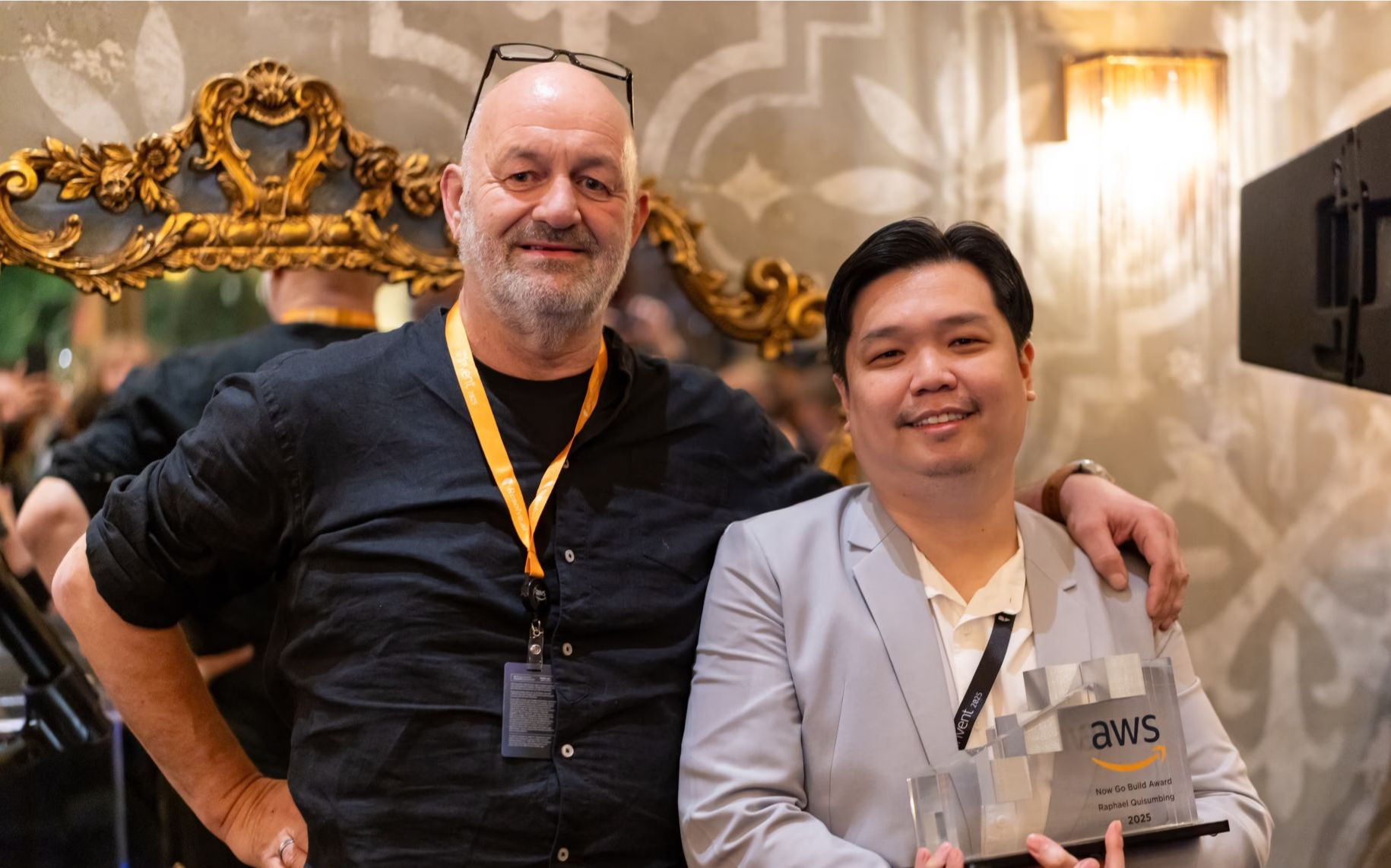
AWS Reinvent 2025
AWS re:Invent 2025: How Agentic AI Is Reshaping Enterprise Cloud Strategy In late November, AWS unveiled a new vision for the cloud that moves beyond “AI experimentation” to a production‑ready...
AWS re:Invent 2025: How Agentic AI Is Reshaping Enterprise Cloud Strategy
In late November, AWS unveiled a new vision for the cloud that moves beyond “AI experimentation” to a production‑ready ecosystem of autonomous agents. For C‑suite executives and technology leaders in regulated sectors—finance, healthcare, energy—the event signals a seismic shift: Amazon is positioning itself as the end‑to‑end platform for cost‑effective, compliant, agentic AI workflows.
Executive Snapshot
- Agentic AI becomes AWS’s flagship offering. Bedrock, SageMaker, and the new Nova foundation models now expose model‑customization APIs that cut inference costs by ~35%.
- Graviton 5 silicon powers the agentic stack. 3.5× higher instructions‑per‑second per watt than Graviton 4; m6g‑5 instances support up to 64 vCPUs with a 40% lower TCO for inference.
- Nova delivers industry‑leading price and latency. Models are priced 30% below GPT‑4o/Claude 3.5, with ~10 ms latency for 1,000‑token prompts in US‑East.
- Security & compliance baked into the stack. Bedrock’s Trusted Execution mode encrypts weights; SageMaker’s Data Privacy Guard masks PII during fine‑tuning.
- Developer ecosystem expands. 12 new AWS certifications for “Agentic AI Engineering” and a HashiCorp partnership that auto‑scales LLM inference demand via Terraform.
The net result? AWS is no longer just a cloud provider—it’s an autonomous‑AI infrastructure vendor. Enterprises now have a compelling reason to shift or expand their AI workloads onto AWS, especially those with stringent regulatory requirements and tight budgets.
Strategic Business Implications for 2025
The re:Invent announcements translate into concrete business levers that executives can pull today:
- Cost‑Efficiency Edge : Graviton 5’s silicon advantage and Nova’s lower pricing give enterprises a 30–40% reduction in per‑token inference costs compared to Microsoft Azure OpenAI or Google Cloud Gemini. For a mid‑market bank running 10 million prompts monthly, that equates to roughly $200,000 saved annually.
- Compliance Confidence : With Trusted Execution and Data Privacy Guard, AWS addresses key audit requirements (PCI‑DSS, HIPAA, GDPR). This reduces the need for costly third‑party compliance tooling and speeds up time‑to‑deployment in regulated environments.
- Speed to Market : Nova’s sub‑10 ms latency enables real‑time customer support bots and clinical decision aids that were previously infeasible on generic LLMs. The 3‑minute CloudFormation stack deployment means pilots can be up and running within a day.
- Ecosystem Momentum : HashiCorp’s Terraform provider for agentic workloads lowers the operational barrier, allowing DevOps teams to integrate autonomous agents into CI/CD pipelines without bespoke scripting.
- : The new “Agentic AI Engineering” certifications signal AWS’s commitment to developer empowerment. Companies can invest in internal training programs that align with this roadmap, reducing skill gaps and retaining top talent.
Technology Integration Benefits for Enterprise Workflows
What does an agentic workflow look like inside a regulated business? Consider the following example: a healthcare provider wants to automate patient triage while ensuring PHI is never exposed outside its secure environment. Using Bedrock’s Trusted Execution mode, the model weights remain encrypted at rest and in transit. SageMaker’s Data Privacy Guard automatically masks PII during fine‑tuning on de‑identified clinical notes. The entire pipeline—data ingestion, model inference, response generation—is orchestrated by a Bedrock endpoint deployed via Terraform. The result is a compliant, cost‑effective triage bot that can be scaled up or down with a single CLI command.
Key technical takeaways:
- Model Customization APIs : Fine‑tune Nova models on proprietary data without exposing sensitive information to external services.
- Native Data Lakehouse Integration : Run inference directly against structured data in the Amazon Data Lakehouse, eliminating costly ETL steps.
- Multi‑Model Orchestration (Upcoming) : AWS is likely to introduce a unified API for coordinating Bedrock, Nova, and third‑party LLMs by 2026, simplifying hybrid deployments.
Market Analysis: AWS vs. Google Cloud & Microsoft Azure
Prior to re:Invent, Google’s TPUs and Azure’s OpenAI offerings dominated the high‑performance AI space. The new benchmarks show AWS closing that gap dramatically:
Graviton 5 (AWS)
TPU v4 (GCP)
Llama‑3‑70B on Azure OpenAI
Cost‑Efficiency (inference per dollar)
2× higher
Baseline
~15% lower latency, similar cost
Latency (1,000‑token prompt)
10 ms (Nova)
12 ms (TPU)
11.5 ms (Azure Llama‑3)
Compliance Features
Trusted Execution + Data Privacy Guard
Limited native compliance tooling
Partial compliance, requires third‑party solutions
For regulated enterprises, the combination of lower cost, faster latency, and built‑in compliance makes AWS a compelling alternative. The question now is whether existing Azure or GCP customers will migrate their agentic workloads to AWS or adopt a multi‑cloud strategy.
ROI Projections for 2025-2027
Below are simplified ROI models for three archetypal use cases:
- Customer Support Automation (Finance) : 10,000 monthly tickets × $0.02 per prompt = $200/month; AWS Bedrock + Nova reduces cost to $120/month → $1,440 saved annually.
- Clinical Decision Support (Healthcare) : 5,000 daily inference requests × $0.05 per request = $91,250/month; Graviton 5 & Nova cut cost by 35% → $59,500/month savings → $715,200/year.
- : Real‑time demand forecasting with 20,000 prompts/day × $0.03 = $18,300/month; AWS’s native Lakehouse inference cuts data movement costs by $5,000/month → $60,000/year.
These figures exclude the intangible benefits of faster time‑to‑market, improved compliance posture, and higher employee productivity—all critical drivers for long‑term competitive advantage.
Implementation Roadmap for Enterprise Leaders
- Assess Current AI Footprint : Map existing LLM workloads across Azure, GCP, or on-prem. Identify those that can benefit from AWS’s lower cost and compliance features.
- Pilot with Bedrock & Nova : Deploy a small‑scale agent (e.g., FAQ bot) using the new model‑customization APIs. Measure latency, cost, and compliance metrics against your baseline.
- Integrate with Data Lakehouse : Shift data pipelines so that inference runs directly within the lakehouse, eliminating costly data exports.
- Secure & Govern : Enable Trusted Execution and Data Privacy Guard from day one. Document audit trails to satisfy regulatory bodies.
- Upskill Teams : Invest in AWS’s new Agentic AI Engineering certifications. Pair developers with security specialists to ensure compliant deployments.
- Plan for Multi‑Model Orchestration (2026) : Keep an eye on AWS’s forthcoming “Multi‑Model Orchestrator” feature, which will allow seamless coordination of Bedrock, Nova, and external LLMs.
Potential Challenges & Mitigation Strategies
- Vendor Lock‑In : While AWS offers a powerful stack, enterprises must design for portability. Adopt containerized agents that can run on any cloud with minimal changes.
- Fine‑Tuning Limits : AWS has not disclosed specific quota limits for Nova fine‑tuning. Mitigate by limiting model updates to critical business domains and using incremental training strategies.
- Interoperability with Third‑Party LLMs : Until the Multi‑Model Orchestrator arrives, integration may require custom adapters. Allocate a small dev team to build reusable connectors.
- Compliance Overhead : Even with built‑in features, regulatory audits demand thorough documentation. Establish a compliance checklist aligned with AWS’s security controls.
Future Outlook: 2026 and Beyond
The trajectory set by re:Invent 2025 points to an increasingly autonomous AI ecosystem:
- Unified Agent Management Console : Expect a web‑based dashboard that visualizes agent performance, cost, and compliance metrics in real time.
- Cross‑Cloud Agent Federation : AWS may enable agents to orchestrate tasks across Azure, GCP, and on‑prem environments, leveraging the best of each platform.
- Standardized OpenAI-Compatible APIs : To reduce lock‑in, AWS could expose a fully OpenAI‑compatible interface for Nova models, easing migration for existing workloads.
- Advanced Governance Tools : Enhanced policy engines that automatically enforce data residency and retention rules at inference time.
Actionable Takeaways for Executives
- Reevaluate your AI budget: AWS’s 30–40% cost savings on LLM inference can free up capital for higher‑value initiatives.
- Prioritize compliance: Leverage Bedrock’s Trusted Execution and SageMaker’s Data Privacy Guard to meet regulatory requirements without extra tooling.
- Accelerate pilots: Use Terraform modules and native Lakehouse integration to spin up agentic workloads in days, not weeks.
- Invest in talent: Upskill teams with AWS’s new Agentic AI Engineering certifications to future‑proof your organization.
- Monitor upcoming features: Stay tuned for the 2026 Multi‑Model Orchestrator and plan migration strategies accordingly.
In short, AWS re:Invent 2025 is not just another cloud conference—it’s a strategic pivot that reshapes how regulated enterprises build, deploy, and govern autonomous AI. The next wave of competitive advantage will belong to those who can turn data into compliant, cost‑efficient action at scale.
Related Articles
Microsoft named a Leader in IDC MarketScape for Unified AI Governance Platforms
Microsoft’s Unified AI Governance Platform tops IDC MarketScape as a leader. Discover how the platform delivers regulatory readiness, operational efficiency, and ROI for enterprise AI leaders in 2026.
Gemini 2.5 Flash‑Lite: The 2025 Game‑Changer for Enterprise AI Workflows
Explore Gemini 2.5 Flash‑Lite, Google’s 10M‑token multimodal model that cuts inference cost by 30% in 2025. Learn how to integrate it on Vertex AI and unlock new enterprise use cases.

Microsoft’s Dual‑Model Copilot: A Strategic Play for Enterprise Productivity in 2025
Executive Summary Microsoft has launched a Smart Mode routing layer that lets Office 365 Copilot switch between GPT‑5 and Anthropic’s Claude 3.5 Sonnet on demand. The move delivers faster, more...