AWS Clean Rooms launches privacy-enhancing synthetic dataset generation for ML model training
Discover how AWS Clean Rooms’ synthetic data engine is reshaping privacy‑first AI in 2025. Learn implementation steps, cost models, and competitive advantages for enterprise architects.
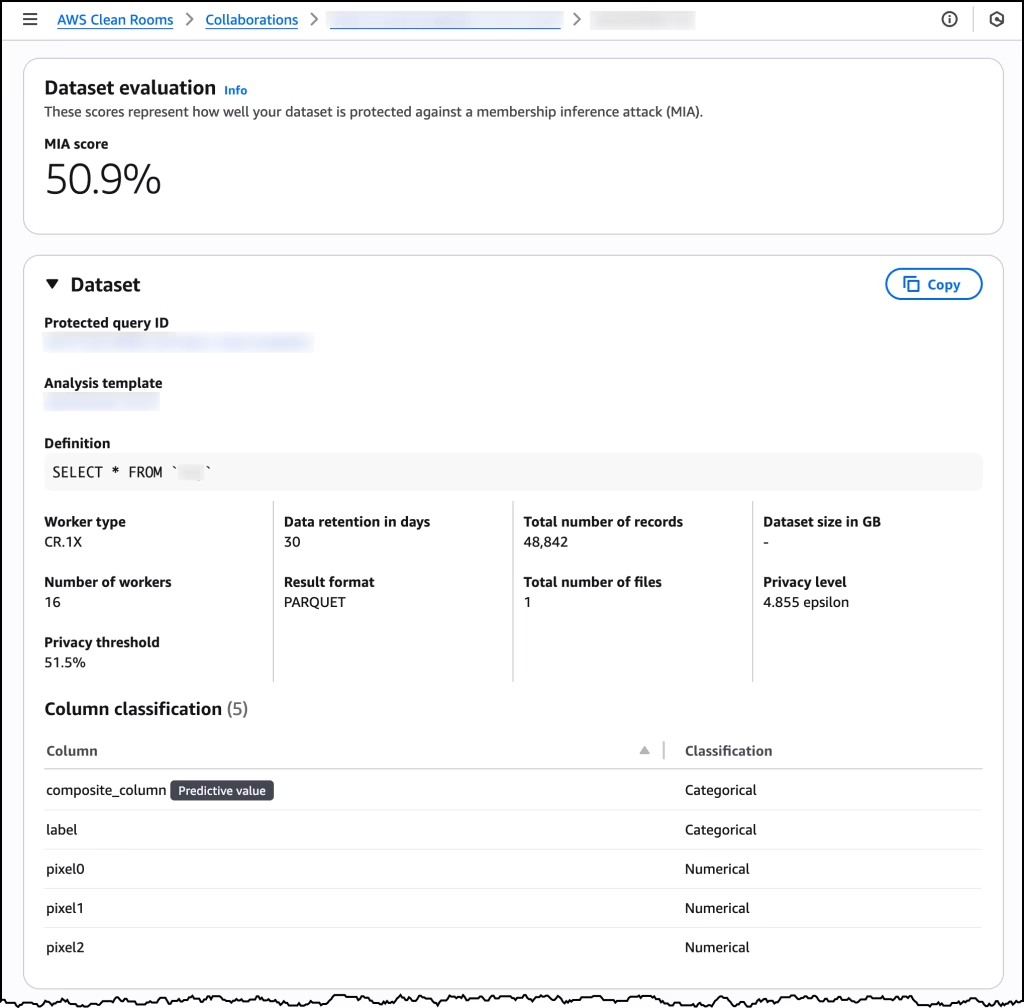
AWS Clean Rooms: Production‑Grade Synthetic Data Engine – 2025 Enterprise Playbook { "@context": "https://schema.org", "@type": "TechArticle", "headline": "AWS Clean Rooms: Production‑Grade Synthetic Data Engine – 2025 Enterprise Playbook", "author": {"@type":"Person","name":"[Your Name]"}, "datePublished":"2025-12-01", "keywords":"AWS Clean Rooms, synthetic data engine, privacy‑enhancing synthetic data, SDGUs, Lake Formation, SageMaker" } AWS Clean Rooms: Production‑Grade Synthetic Data Engine – 2025 Enterprise Playbook In December 2025, AWS launched a fully managed synthetic data engine that delivers privacy‑enhancing synthetic data (PESD) at enterprise scale. The new AWS Clean Rooms service integrates directly with Lake Formation, Glue, and SageMaker, giving regulated organizations a turnkey path to share insights without exposing raw customer or patient records. AWS Clean Rooms: Strategic Business Implications The engine touches every layer of an enterprise data‑to‑AI workflow. Its impact can be distilled into three domains: Compliance Automation : Built‑in KL‑divergence and membership‑inference scores provide auditors with concrete, auditable privacy metrics. Operational Efficiency : Generation finishes in hours, priced per Synthetic Data Generation Unit (SDGU), and integrates natively into existing Glue catalogs. Competitive Positioning : AWS becomes the only cloud provider offering a production‑grade PESD pipeline that supports multi‑party ML training—outpacing federated learning and other privacy tools. Compliance Meets Automation Regulators such as GDPR, CCPA, and HIPAA demand that personal data not be exposed beyond strict boundaries. AWS Clean Rooms automates noise injection with per‑column epsilon settings and inherits Lake Formation policies, eliminating the need for separate governance layers. Lake Formation documentation explains how policy inheritance works in practice. The service also publishes public fidelity scores (KL‑divergence privacy threshol
Related Articles

OpenAI launches cheaper ChatGPT subscription, says ads are coming next
OpenAI subscription strategy 2026: how ChatGPT Go and privacy‑first ads reshape growth, cash flow, and enterprise adoption in generative AI.
Anthropic launches Claude Cowork, a version of its coding AI for regular people
Explore Claude Cowork, Anthropic’s no‑code AI agent launching in 2026—boosting desktop productivity while keeping data local.

Google Releases Gemma Scope 2 to Deepen Understanding of LLM Behavior
Gemma Scope 2: What Enterprise AI Leaders Need to Know About Google’s Rumored Diagnostic Suite in 2026 Meta‑description: Explore the latest evidence on Gemma Scope 2, Google’s alleged LLM diagnostic...