The Race to the Full SDLC AI Platform: Why Enterprise-Grade Autonomous Agents Will Define the Next Software Giant
Explore how autonomous SDLC agents powered by GPT‑4o, Claude 3.5 Sonnet, and Gemini 1.5 Pro are reshaping software delivery, cutting costs, and enabling new revenue streams for 2026 enterprises.
Autonomous SDLC Agents: Driving Enterprise Agility and Profitability in 2026 Executive Summary The convergence of advanced reasoning LLMs—GPT‑4o, Claude 3.5 Sonnet, and Gemini 1.5 Pro—agent‑driven workflows, and optical acceleration is transforming the software development life cycle (SDLC) from a labor‑intensive process into an autonomous, end‑to‑end engine. In 2026, enterprises that adopt AI‑powered SDLC platforms can expect: Up to 70 % reduction in feature delivery time . A 30–50 % decrease in engineering headcount costs through automated design, coding, testing, and deployment. Compliance and auditability that meets EU data‑protection mandates while maintaining US performance standards. New revenue streams via Agent‑as‑a‑Service (AaaS) offerings and cross‑modal product integrations. The following analysis translates cutting‑edge research into concrete strategic actions for CIOs, CTOs, CFOs, and product leaders. Strategic Business Implications of the Reasoning Era OpenAI’s GPT‑4o, released in early 2026, merges rapid conversational responses with deep tool‑using reasoning. This shift eliminates the “chat‑only” versus “o‑series reasoning” dichotomy that previously limited LLM deployment to either quick prompts or specialized analytical tasks. Operational Impact : Autonomous agents can now generate architecture diagrams, write unit tests, and trigger CI/CD pipelines—all within a single prompt cycle. The result is a continuous delivery pipeline that requires minimal human intervention. Leadership Opportunity : Executives must pivot from managing code reviews to overseeing agent governance, bias mitigation, and compliance auditing. Competitive Advantage : Companies that embed reasoning LLMs into their product roadmaps can iterate faster than rivals still bound by manual coding loops. The AI‑SDLC Platform: A Market Game Changer ParkerRex’s ai‑sdlc is the first open‑source, agent‑driven workflow that mirrors industry best practices. Its eight‑step markdown pipeline—ide
Related Articles
Microsoft named a Leader in IDC MarketScape for Unified AI Governance Platforms
Microsoft’s Unified AI Governance Platform tops IDC MarketScape as a leader. Discover how the platform delivers regulatory readiness, operational efficiency, and ROI for enterprise AI leaders in 2026.
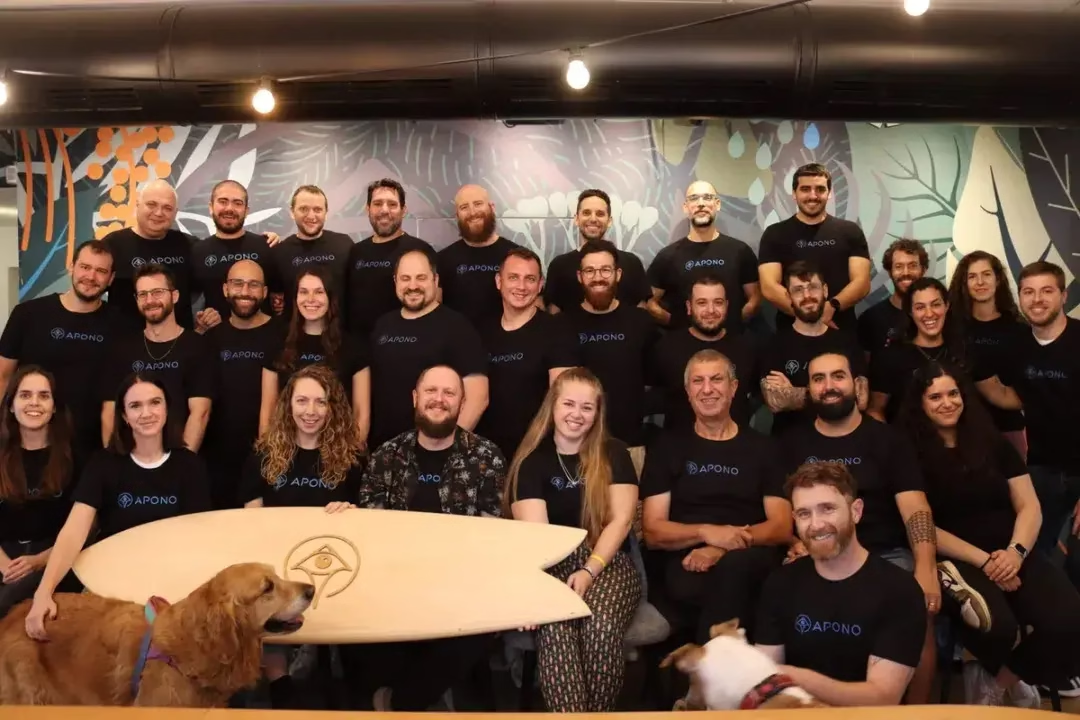
Apono raises $34M to tackle cloud privilege sprawl with Zero Standing Privilege model
Apono Secures $34 Million Series B: What It Means for Identity Security and Enterprise Growth in 2025 Executive Snapshot Series B of $34 million fuels Apono’s AI‑driven Zero Standing Privilege (ZSP)...

Training Large Language With These Features - AI2Work Analysis">Models Without Code: Strategic Benefits and Technical Realities in 2025
In 2025, the AI landscape is witnessing a profound shift: the ability to train, fine-tune, and customize large language models (LLMs) without writing a single line of code . This evolution, powered...