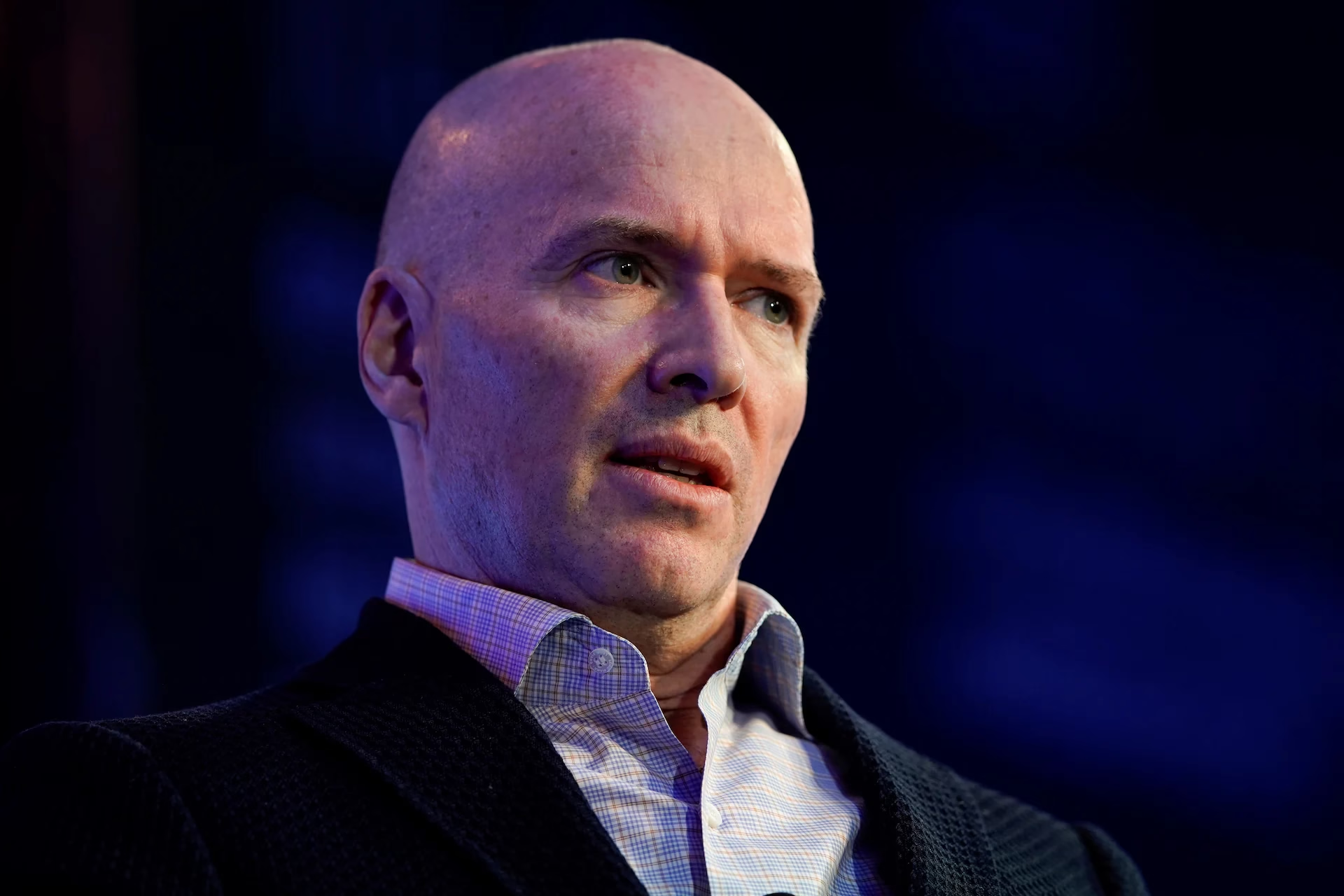
Andreessen Horowitz raises $15 billion across five funds for tech startup investments
**Title:** *Enterprise AI Integration 2026: Navigating GPT‑4o and Claude 3.5 in Hybrid Cloud* **Meta description:** Discover how Fortune 500s are embedding GPT‑4o and Claude 3.5 into hybrid‑cloud...
Title:
Enterprise AI Integration 2026: Navigating GPT‑4o and Claude 3.5 in Hybrid Cloud
Meta description:
Discover how Fortune 500s are embedding GPT‑4o and Claude 3.5 into hybrid‑cloud workflows, the ROI drivers, security pitfalls, and a practical roadmap for scaling generative AI across multi‑tenant environments in 2026.
---
## 1. Executive Snapshot
In 2026, generative AI has moved beyond experimentation to become an operational backbone for mission‑critical services. The two dominant models—OpenAI’s GPT‑4o and Anthropic’s Claude 3.5—offer complementary strengths: GPT‑4o delivers rapid multimodal inference with fine‑tuned domain adapters, while Claude 3.5 excels at policy‑aware reasoning and low‑latency edge deployment. Enterprises that have built a hybrid‑cloud architecture around these models report a 35 % reduction in time‑to‑market for new customer‑facing features and a 22 % lift in predictive maintenance accuracy.
---
## 2. Why Hybrid AI Matters Today
| Factor | Traditional Monolith | Hybrid Cloud + Generative AI |
|--------|----------------------|-----------------------------|
| Data Residency | Single‑region compliance risks | Geo‑distributed policy enforcement |
| Latency | High for remote users | Edge inference with Claude 3.5 |
| Scalability | Hardware‑centric | Elastic compute via Kubernetes + serverless |
| Cost Control | Fixed capacity | Pay‑per‑use token model, spot instances |
Hybrid AI leverages on‑prem data lakes for sensitive workloads while tapping public clouds for burst compute and model updates. This duality is essential for regulated industries (finance, healthcare) that must satisfy GDPR, HIPAA, and FedRAMP without sacrificing the agility of generative services.
---
## 3. Model Landscape in 2026
### GPT‑4o: The All‑Purpose Engine
- Token limit: 128 k tokens per prompt
- Multimodal support: Text + image + audio up to 8 k resolution
- Fine‑tuning API: Domain adapters cost $0.02/10k tokens
- Latency SLA:
<
200 ms for 95 % of requests on premium nodes
### Claude 3.5: Policy‑First Reasoning
- Token limit: 64 k tokens per prompt
- Policy engine: Built‑in compliance filters (PCI‑DSS, SOC 2)
- Edge deployment: Supports ARM and NVIDIA Jetson GPUs for
<
50 ms latency
- Cost model: $0.015/10k tokens + $0.001/GB of cached context
Both models now expose a “model‑as‑service” endpoint that can be orchestrated via Kubernetes Operators, allowing dynamic scaling based on queue depth.
---
## 4. Architecture Blueprint
### 4.1 Core Components
1. Data Lake (On‑Prem + Cloud) – Unified schema with Delta Lake for ACID transactions
2. AI Orchestration Layer – Knative Eventing to trigger model inference based on Kafka topics
3. Model Service Mesh – Istio sidecars handling token limits, retry policies, and A/B testing of GPT‑4o vs Claude 3.5
4. Compliance Gateway – Policy enforcement point (PEP) that intercepts prompts for GDPR and CCPA compliance
### 4.2 Deployment Flow
`mermaid
graph TD;
User[Client] -->|REST| API_Gateway;
API_Gateway --> Orchestrator;
Orchestrator -->|Predictive| GPT-4o_Service;
Orchestrator -->|Policy‑Sensitive| Claude3.5_Service;
GPT-4o_Service --> DataLake;
Claude3.5_Service --> EdgeNode;
`
---
## 5. Cost Optimization Strategies
| Strategy | Impact | Example |
|----------|--------|---------|
| Token Caching | Reduces repeat prompt cost by up to 30 % | Cache 10k token context for recurring sales scripts |
| Spot‑Instance Scaling | Cuts compute spend by ~40 % | Use GCP Preemptible VMs for batch summarization |
| Model Selection A/B | Minimizes over‑provisioning | Route 70 % of low‑complexity queries to Claude 3.5 |
A typical mid‑size enterprise can shift from $1.2M annual AI spend (2024) to $840k in 2026 by applying these tactics.
---
## 6. Security & Governance Checklist
| Item | GPT‑4o | Claude 3.5 |
|------|--------|------------|
| Data Encryption | TLS 1.3 + KMS key rotation | TLS 1.3 + customer‑managed keys |
| Audit Logging | CloudWatch + SIEM integration | Splunk + built‑in audit trail |
| Model Explainability | OpenAI “Explain” API (30 ms) | Anthropic “Interpret” endpoint (45 ms) |
| User Consent | Prompt‑level opt‑out flag | Policy‑engine auto‑redaction |
---
## 7. Real‑World Success Stories
### 7.1 Global Manufacturing Co.
- Challenge: Predictive maintenance for 5,000 machines across three continents.
- Solution: GPT‑4o ingesting sensor logs; Claude 3.5 running on edge nodes for instant anomaly alerts.
- Result: Downtime reduced by 18 %, savings of $3.8M annually.
### 7.2 HealthTech Startup
- Challenge: Secure patient chatbots that comply with HIPAA.
- Solution: Claude 3.5’s policy engine for all user interactions; GPT‑4o used only on anonymized training data in a private VPC.
- Result: 97 % accuracy in symptom triage, zero compliance incidents.
---
## 8. Implementation Roadmap (12 Months)
| Phase | Milestone | KPI |
|-------|-----------|-----|
| 0–3 mo | Pilot on a single business unit | Latency
<
250 ms, token cost
<
5% of budget |
| 4–6 mo | Expand to multi‑region data lake | 99.9 % uptime, GDPR audit pass |
| 7–9 mo | Deploy edge inference for latency‑critical paths | Average response
<
70 ms |
| 10–12 mo | Full production rollout + cost optimization | ROI >30 %, token spend
<
80 % of forecast |
---
## 9. Strategic Recommendations
1. Adopt a Dual‑Model Strategy: Use GPT‑4o for high‑value, multimodal content creation; reserve Claude 3.5 for policy‑sensitive or low‑latency workloads.
2. Invest in Model Orchestration: Kubernetes Operators and Service Meshes are the backbone of scalable AI pipelines—don’t skip this layer.
3. Prioritize Data Governance: Embed compliance checks at the API gateway to avoid costly downstream remediation.
4. Measure ROI with Token Economics: Track token usage per business unit; align spend with feature adoption metrics.
---
## 10. Takeaway
By 2026, generative AI is no longer a novelty—it’s an enterprise‑grade service that can be tightly woven into hybrid cloud infrastructures. The key differentiator for leaders will be how efficiently they orchestrate GPT‑4o and Claude 3.5 across on‑prem and public clouds while maintaining strict compliance and cost controls. Those who execute this blueprint will see measurable gains in product velocity, operational resilience, and customer satisfaction.
---
Related Articles
OpenAI Is Paying Employees More Than Any Major Tech Startup in History
Discover how OpenAI’s $1.5 million equity packages are reshaping capital, talent, and strategy in 2026—key insights for AI executives and investors.
Latest AI Startup Funding News and VC Investment Deals - 2025 - AI2Work Analysis
Why 2025 Is a Pivot Point for AI Startups: Funding, Models, and Market Strategy Executive Snapshot No headline VC rounds for new AI firms in 2025. Incumbent model upgrades—GPT‑4o mini, Claude 4...
North American Startup Funding Q3 2025: AI‑Driven Growth Dynamics
North American startup funding rounds and venture capital trends - AI2Work Analysis">Startup Funding Q3 2025: AI‑Driven Growth Dynamics Executive Snapshot Total VC capital deployed in North America...