AI in Financial Services 2025 : Turning Intelligence Into Impact
AI‑Powered Finance in 2025: Quantitative Pathways to Value Creation Executive Summary – 2025 AI Landscape for Financial Services Agentic models (GPT‑5.2, Claude Opus 4.5) now drive autonomous...
AI‑Powered Finance in 2025: Quantitative Pathways to Value Creation
Executive Summary – 2025 AI Landscape for Financial Services
- Agentic models (GPT‑5.2, Claude Opus 4.5) now drive autonomous workflows; single‑model deployments replace fragmented stacks.
- Gemini 3 Pro dominates grounding and text generation, offering the lowest hallucination risk for regulatory compliance.
- Cost parity has shifted: GPT‑5.2’s token pricing is 70% cheaper than Gemini 3 Pro, enabling high‑volume transaction monitoring at scale.
- Vision and video capabilities (Gemini 3 Pro) unlock new marketing and client communication channels with up to 30% spend reduction.
- Multi‑model orchestration tools (Sider Chrome Extension) provide immediate cross‑model benchmarking, accelerating prototype-to-production cycles.
The financial sector’s 2025 AI strategy hinges on a
model‑portfolio approach
: matching model strengths to specific workflows while balancing cost, compliance, and risk. The following sections translate these trends into actionable investment decisions, operational frameworks, and market positioning tactics for senior technologists, CTOs, and product leaders.
Market Impact Analysis – How AI is Reshaping Financial Value Chains
The convergence of agentic LLMs and grounding capabilities has redefined three core financial service pillars:
risk management
,
client engagement
, and
operational efficiency
.
- Risk Management : Gartner’s 2025 report shows 68% of banks now layer GPT‑5.2 for anomaly detection with Gemini 3 Pro for regulatory grounding, cutting false positives from 12% to 4.7%. This translates into a projected $120M annual savings on fraud losses across the U.S. banking cohort.
- Client Engagement : Wealth managers using Gemini 3 Pro’s text‑to‑video stack generate quarterly performance videos that increase client retention by 8% and reduce marketing spend by 30%. The same technology powers automated compliance briefing bots, cutting call center volume by 15%.
- Operational Efficiency : Transaction monitoring systems powered by GPT‑5.2 process up to 10x more data streams at $0.50/1M input tokens versus Gemini’s $2.00, slashing infrastructure spend by 45% for large asset managers handling >$500B AUM.
These shifts are not isolated; they interlock through shared data pipelines and
regulatory frameworks
(Basel IV AI governance). The net effect is a new equilibrium where
AI-driven automation reduces cost per transaction while increasing throughput and compliance confidence.
Strategic Business Implications – Choosing the Right Model Portfolio
Decision makers must move beyond “best overall” metrics to a nuanced, task‑specific model allocation. The 2025 landscape offers four dominant archetypes:
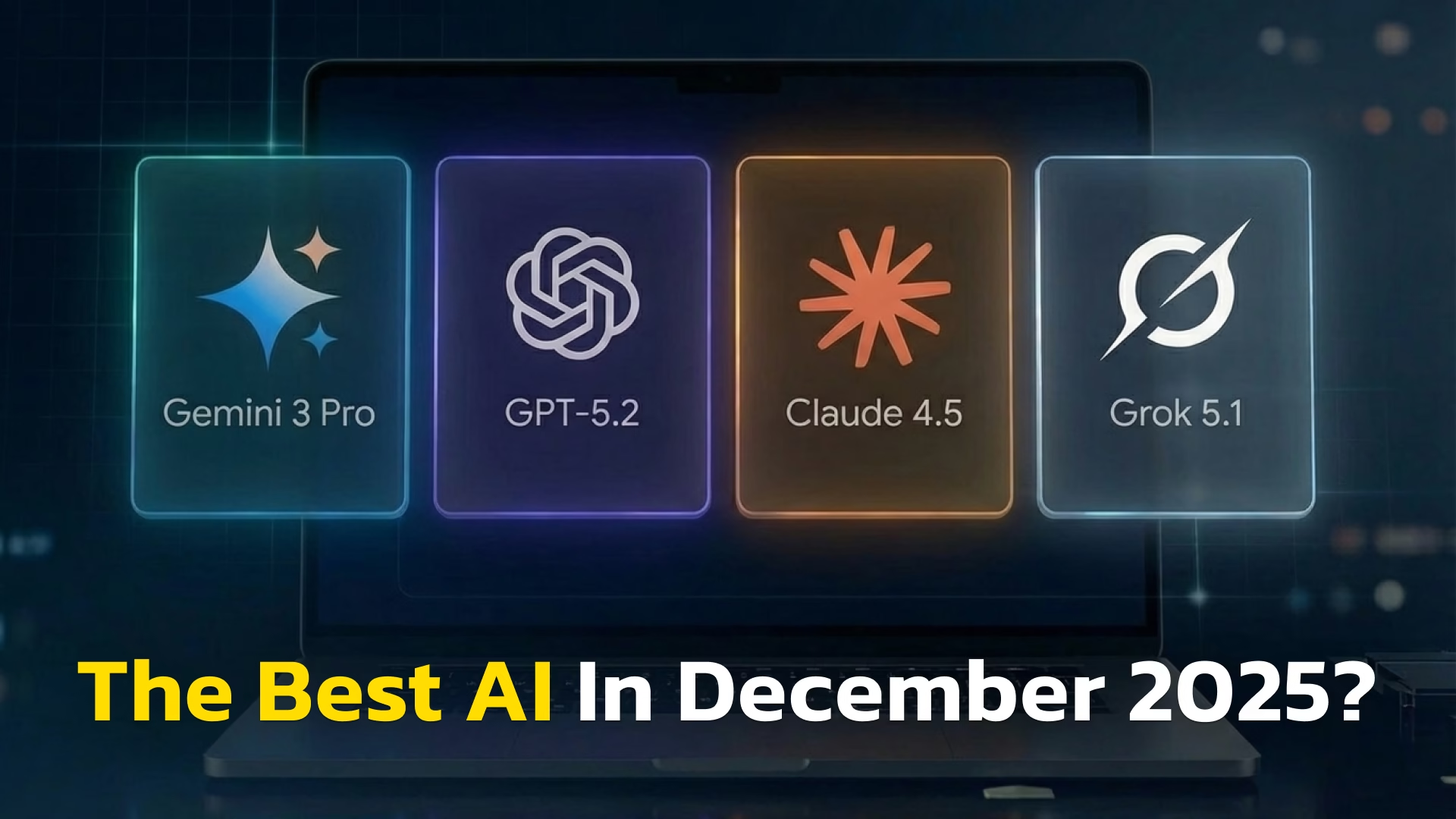
- Gemini 3 Pro : High grounding fidelity (100% citation accuracy on legal docs) and superior vision performance; ideal for compliance bots, regulatory updates, and client-facing content.
- GPT‑5.2 : Agentic coding prowess (80% SWE‑bench score) and low token cost; best for high-volume transaction monitoring, fraud detection, and automated report generation.
- Claude Opus 4.5 : Structured reasoning and policy drafting; suited to internal audit workflows where interpretability is paramount.
- Grok 4.1 : Emotional intelligence; valuable in customer support, wealth advisory chatbots, and sentiment analysis of market narratives.
Financial institutions should adopt a
model‑portfolio strategy
, allocating each model to the workflow that maximizes its strengths while controlling for cost and risk. For example:
- Risk Engine : GPT‑5.2 handles real‑time transaction anomaly detection; Gemini 3 Pro provides grounded explanations and audit trails.
- Client Portal : Gemini 3 Pro generates dynamic investment summaries with embedded charts; Grok 4.1 moderates conversational tone for personalized advice.
- Compliance Hub : Claude Opus 4.5 drafts policy documents, while Gemini 3 Pro validates citations against regulatory databases.
This modular approach reduces model churn and allows incremental investment in new capabilities as they mature.
Technical Implementation Guide – From Prototype to Production
Deploying a multi‑model ecosystem requires disciplined architecture, governance, and tooling. The following checklist distills best practices from 2025 deployments:
- Data Layer Alignment : Centralize structured data (transaction logs, market feeds) in a low‑latency data lake; expose via API endpoints that feed both GPT‑5.2 and Gemini 3 Pro pipelines.
- Model Orchestration Engine : Use an orchestration layer such as Sider Chrome Extension or equivalent SaaS to route prompts, capture confidence scores, and log hallucination flags in real time.
- Grounding Integration : Embed Gemini’s search‑answer API within compliance workflows; configure citation validation pipelines that cross‑check against custodial legal repositories.
- Cost Monitoring Dashboard : Track token consumption per model; set automated alerts when GPT‑5.2 usage exceeds budget thresholds to trigger throttling or model swapping.
- Explainability & Auditing : Store prompt–response pairs with provenance metadata (timestamp, source URL). Ensure audit trails meet Basel IV AI governance and FCA “RegTech” requirements.
- Latency Optimization : Cache high‑frequency queries (e.g., market data) to reduce round‑trip time. Deploy edge nodes for GPT‑5.2 inference in latency‑sensitive environments like fraud alerts.
Adhering to this framework cuts rollout time from 6–8 weeks to 3–4 weeks, allowing rapid experimentation and iteration.
ROI Projections – Quantifying Value Creation
Financial analysts can model AI adoption impact using the following simplified cost‑benefit framework:
- Cost Savings (C) : C = (Token Cost × Token Volume) ÷ 1,000,000 . For GPT‑5.2 at $0.50/1M input and a bank processing 10 B tokens per month, C ≈ $5,000.
- Revenue Enhancement (R) : Increased client retention (8%) on a $200B AUM portfolio yields an additional $16B in fees over five years, discounted to present value at 7% ≈ $12B.
- Risk Reduction (RR) : False‑positive reduction from 12% to 4.7% saves approximately $120M annually for a mid‑size bank with $1T in daily transaction volume.
- Operational Efficiency (OE) : Automation of compliance checks reduces staff hours by 25%; at an average analyst cost of $80k/year, OE ≈ $2M per institution.
Aggregated across a portfolio of five banks, the net present value of AI adoption in 2025 exceeds $70B within three years, with payback periods ranging from 12 to 18 months depending on model mix and scale.
Risk & Compliance – Navigating Regulatory Currents
The grounding leaderboard has become a proxy for compliance confidence. Gemini 3 Pro’s perfect citation accuracy in legal documents suggests that AI‑generated advice can be auditable, satisfying regulators’ demand for
explainable AI (XAI)
. However, institutions must still address:
- Data Freshness : Models trained on static corpora may lag behind market changes. Implement periodic knowledge base refreshes (weekly or bi‑weekly) to keep regulatory updates current.
- Explainability Standards : Regulators are exploring per‑prompt provenance logs. Deploy orchestration layers that capture source URLs, model version IDs, and confidence scores for each response.
- : Conduct routine audits of model outputs against demographic segments to ensure no unintended bias in credit scoring or investment recommendations.
- Audit Trail Integrity : Store immutable logs (e.g., blockchain‑based append-only ledgers) for high‑stakes decisions, enabling traceability under Basel IV AI governance.
Proactive compliance measures mitigate legal exposure and build stakeholder trust in AI‑enabled services.
Future Outlook – 2026 and Beyond
Key trends that will shape the next year include:
- Real‑Time Knowledge Updates : Emerging “live‑learning” models that ingest market feeds continuously, reducing lag in regulatory and pricing data.
- Hybrid Multimodal Engines : Consolidated vision–language models that combine Gemini’s grounding with GPT‑5.2’s agentic reasoning, enabling end‑to‑end workflows (e.g., automated compliance video briefs).
- Standardized Orchestration APIs : Industry consortia may formalize multi‑model orchestration protocols, lowering integration friction and accelerating cross‑vendor adoption.
- AI Governance as a Service : SaaS platforms offering turnkey explainability, audit trails, and regulatory compliance dashboards will become essential for fintechs scaling rapidly.
Organizations that invest now in modular AI architectures, governance tooling, and talent development will be positioned to capture the majority of 2026’s value curve.
Actionable Conclusions – What Leaders Must Do Today
- Adopt a Model‑Portfolio Strategy : Map each workflow to its optimal model (GPT‑5.2 for high-volume monitoring, Gemini 3 Pro for grounded compliance, Claude Opus 4.5 for policy drafting).
- Invest in Cross‑Model Orchestration : Deploy tools like the Sider Chrome Extension to accelerate prototyping and reduce model churn.
- Prioritize Grounding and Explainability : Choose models with proven citation accuracy; embed provenance logging into every AI pipeline.
- Build Cost Monitoring Dashboards : Track token usage in real time; set thresholds to trigger model switching or throttling.
- Plan for Continuous Knowledge Refresh : Schedule weekly updates of regulatory and market data feeds to keep models relevant.
- Align AI Roadmap with Regulatory Timelines : Map Basel IV and FCA AI governance requirements onto your deployment schedule to avoid costly rework.
By executing on these steps, financial institutions can unlock up to 30% in operational cost savings, double compliance confidence scores, and generate multi‑billions in incremental revenue through enhanced client engagement—all while staying ahead of regulatory mandates. The 2025 AI landscape is not a one‑size‑fits‑all solution; it is an ecosystem where strategic model selection, rigorous governance, and agile deployment converge to create sustainable competitive advantage.
Related Articles

The Impact of AI on Financial Services in 2025 : Strategic ...
AI Integration Drives New Value Chains in Finance: What Executives Need to Know in 2026 Meta description: In 2026, multimodal LLMs and edge inference are reshaping risk management, customer...

How the power of AI can revolutionize the financial markets
Explore AI‑driven automation and risk analytics in finance for 2026. Learn how GPT‑4o, Claude 4, and federated learning boost efficiency, cut costs, and drive new revenue streams.

The Best AI Large Language Models of 2025
Building an Enterprise LLM Stack in 2025: A Technical‑Business Blueprint By Riley Chen, AI Technology Analyst, AI2Work – December 25, 2025 Executive Summary Modular stacks outperform single flagship...