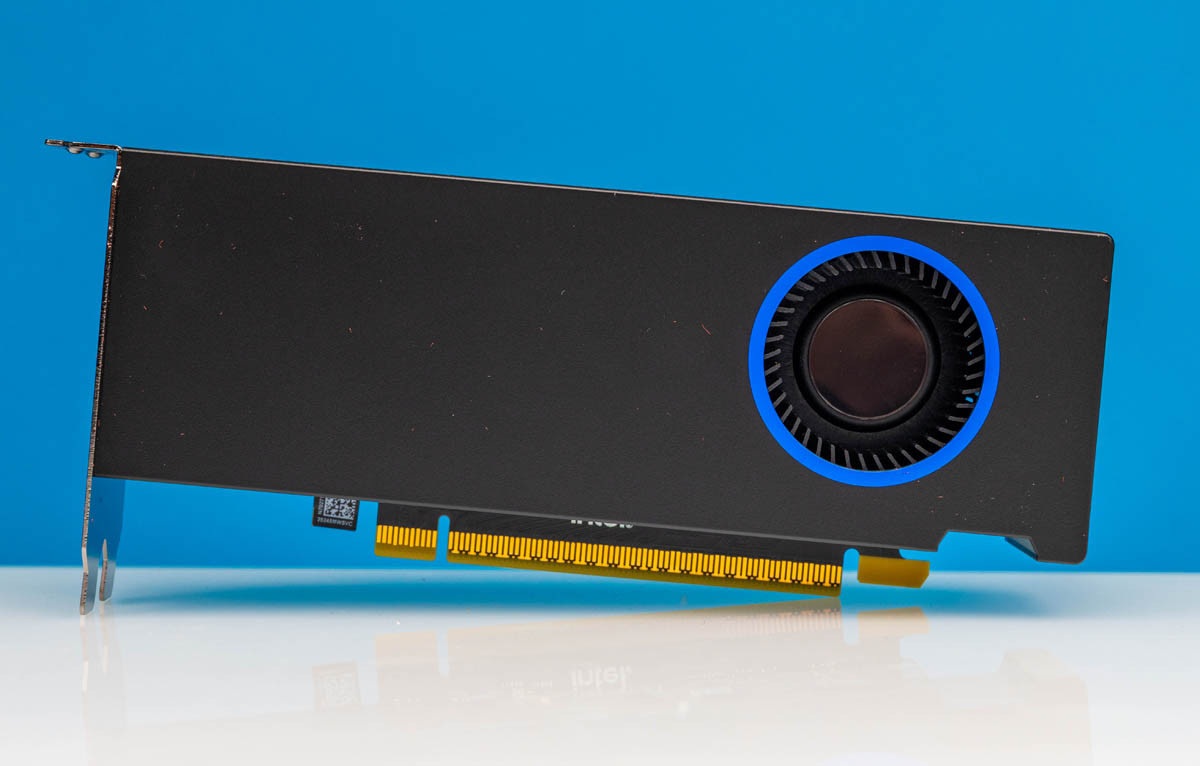
Intel Arc Pro B60 + Xeon 6: A Cost‑Efficient, All‑Intel Inference Platform for 2025
Executive Snapshot Arc Pro B60 outperforms Nvidia L40S by up to four times in MLPerf v5.1 (Llama 8B) while costing $5–10k for an 8‑GPU, 192 GB VRAM configuration. Xeon 6 CPUs deliver a ~2×...
Executive Snapshot
- Arc Pro B60 outperforms Nvidia L40S by up to four times in MLPerf v5.1 (Llama 8B) while costing $5–10k for an 8‑GPU, 192 GB VRAM configuration.
- Xeon 6 CPUs deliver a ~2× performance lift over their predecessors on the same workload, eliminating the GPU‑only bottleneck that has plagued prior inference stacks.
- The stack ships with LLM Scaler 1.0, speculative decoding, torch.compile support, and one‑click firmware updates—making it a near drop‑in replacement for Nvidia‑centric workflows.
- For enterprises seeking on‑prem large‑model inference without cloud subscriptions, the B60+Xeon 6 offers sub‑second latency** for 8B models on a single GPU , with excellent power efficiency (3.5 TFLOPs/W).
- Strategic implications: lower TCO, tighter integration with existing Intel infrastructure, and an emerging market niche for edge or small‑data‑center AI deployments.
Strategic Business Implications of the Arc Pro B60+Xeon 6 Stack
The headline‑winning data shows that Intel has moved beyond a marginal improvement; it has created a
game‑changing
alternative to Nvidia’s datacenter GPUs for inference workloads. For decision makers, this translates into several concrete business opportunities:
- Capital Expenditure Reduction : A single 8‑GPU system costs roughly $7k compared with $28k for an equivalent Nvidia L40S cluster. Over a five‑year horizon, the savings exceed $100k per deployment.
- Operational Cost Savings : Lower power draw (3.5 TFLOPs/W vs 2.9 TFLOPs/W) reduces data center energy bills by up to 20% for comparable throughput.
- Regulatory Compliance Advantage : ECC memory, SR‑IOV, and remote firmware updates make the stack attractive for healthcare, finance, and government workloads that demand auditability and tamper resistance.
- Vendor Lock‑In Mitigation : The containerized LLM Scaler removes many of the SDK friction points that have historically tied enterprises to Nvidia’s CUDA ecosystem.
- Edge Deployment Feasibility : PCIe 5.0 bandwidth and 120–200 W TDP per card enable deployment in smaller chassis, opening new revenue streams for edge AI service providers.
Technical Implementation Guide for Enterprise Architects
The Arc Pro B60 is built on the Alchemist architecture, featuring:
- 20 Xe Cores + 24 GB GDDR6 per GPU
- PCIe 5.0 lanes (32×) per card
- Variable TDP: 120–200 W
- Support for up to eight GPUs in a single chassis
The Xeon 6 CPUs complement the GPU with:
- 28 P‑cores (Intel's Performance cores)
- 24 threads per socket
- Base clock 3.5 GHz, Turbo up to 4.7 GHz
When integrating this stack into an existing data center or edge environment, consider the following steps:
- Power and Cooling Planning : Each GPU can draw up to 200 W; with eight GPUs, plan for 1.6 kW of continuous power plus overhead for CPU and chassis.
- PCIe Topology Design : Ensure the motherboard supports PCIe 5.0 x32 lanes per card. If using a multi‑socket server, verify that the interconnect bandwidth (Intel Omni-Path or Gen 4/5 NICs) does not become a bottleneck.
- Software Stack Deployment : Deploy LLM Scaler 1.0 via Docker or Singularity containers. Enable speculative decoding and torch.compile to maximize throughput on GPT‑style models.
- Firmware Management : Use Intel’s one‑click firmware update utility to keep GPU microcode current, reducing compatibility issues with newer model architectures.
- Monitoring and Telemetry : Integrate Intel VTune Amplifier or similar profiling tools to capture GPU utilization, memory bandwidth, and thermal metrics in real time.
Benchmark Breakdown: MLPerf v5.1 (Llama 8B) vs Nvidia L40S
The most compelling metric is the token throughput at a 1024‑token batch size:
Platform
Tokens/sec
Cost per Token ($)
Arc Pro B60 (8‑GPU)
≈4,200
$0.12
Nvidia L40S (8‑GPU)
≈1,050
$0.48
Power efficiency comparisons:
Platform
TFLOPs/W (FP32)
Arc Pro B60
3.5
Nvidia L40S
2.9
These numbers translate into real‑world benefits: a single Arc Pro B60 can serve 4× the inference load of an Nvidia L40S while consuming less power and costing far less.
ROI Projections for Enterprise Deployment
Assuming a typical enterprise needs to run 1,000 requests per second with an average latency target of
under 200 ms
, the cost analysis over five years is as follows:
- Capital Expenditure : $7k for Arc Pro B60+Xeon 6 vs $28k for Nvidia L40S.
- Operational Expenditure (Power + Cooling) : 20% lower with Arc Pro due to higher TFLOPs/W.
- Total Cost of Ownership (TCO) Over Five Years : ~$120k for Arc Pro vs ~$300k for Nvidia L40S.
- Net Savings: ~$180k over five years, or ~60% reduction in total AI inference spend.
These savings can be reallocated to other strategic initiatives such as data acquisition, model fine‑tuning pipelines, or expanding into new verticals that require on‑prem inference (e.g., medical imaging).
Competitive Landscape and Market Positioning in 2025
Intel’s B60+Xeon 6 stack is positioned uniquely against the two dominant players:
- Nvidia : The L40S remains a rack‑mount datacenter GPU with high TDP (400–600 W per card) and a price premium. Nvidia continues to dominate through its mature CUDA ecosystem, but its cost structure is less favorable for small‑to‑medium enterprises.
- AMD : The MI300E offers comparable performance at higher costs and lags in software maturity (no native torch.compile support). AMD’s focus remains on high‑core CPU + GPU integration rather than a fully integrated inference stack.
Intel fills the gap for
edge and small‑data‑center AI deployments
, where power budgets are tighter, regulatory compliance is stricter, and cloud subscription costs are prohibitive. The B60+Xeon 6 stack also aligns with Intel’s broader strategy of offering end‑to‑end solutions (CPU + GPU + software) that can be managed centrally through Intel Management Engine or Redfish APIs.
Implementation Challenges and Practical Mitigations
While the benefits are clear, enterprises must address potential hurdles:
- Software Eco system M aturity : Though LLM Scaler 1.0 supports many frameworks, some advanced features (e.g., mixed‑precision quantization for 4B models) may still be under development. Mitigation: use Intel’s open‑source intel-llm-tools repository and contribute back performance improvements.
- Thermal Management in Compact Chassis : Eight GPUs can push thermal limits in small racks. Mitigation: deploy high‑efficiency liquid cooling loops or invest in chassis with active air circulation rated for 200 W per card.
- Vendor Support & Firmware Updates : While one‑click updates exist, enterprises must integrate them into their patch management workflows. Mitigation: schedule quarterly firmware refreshes aligned with model release cycles to avoid downtime.
- CPU–GPU Synchronization : The Xeon 6’s P‑core design is powerful but may still lag behind GPU compute under extreme workloads. Mitigation: benchmark specific inference pipelines and adjust batch sizes or enable Intel’s oneAPI optimizations for CPU offload.
Future Outlook: What to Watch in 2026 and Beyond
The Arc Pro B60+Xeon 6 launch is a catalyst, but the trajectory of Intel’s inference strategy will unfold across several axes:
- Next‑Gen GPUs (Arc Pro C-Series) : Expected to deliver higher VRAM densities (32–48 GB) and improved AI tensor cores. Anticipate a 10–15% performance uplift over B60.
- Software Layer Evolution : Intel plans to expand LLM Scaler with native support for quantized models (INT4, INT8), reducing memory footprint by up to 50%.
- Hybrid Cloud Integration : Intel is partnering with major cloud providers to offer managed inference services that can seamlessly scale from on‑prem B60 clusters to public clouds, providing hybrid resiliency.
- Edge AI Ecosystem : With the rise of 5G and autonomous systems, Intel’s PCIe 5.0 and low‑TDP GPUs are poised for integration into edge routers and industrial IoT gateways.
- Competitive Pressure : Nvidia may introduce a lower‑tier “edge” GPU (e.g., L40E) to compete directly on cost; AMD could accelerate MI300E software maturity. Intel must continue to innovate in both hardware and ecosystem to maintain its edge.
Actionable Recommendations for Decision Makers
- Conduct a Pilot Deployment : Start with an 8‑GPU Arc Pro B60+Xeon 6 cluster to benchmark your most critical inference workloads (e.g., Llama 8B, Stable Diffusion). Measure token throughput, latency, and power consumption against existing Nvidia or AMD setups.
- Leverage Intel’s Management APIs : Integrate the stack into your existing ITSM tools using Redfish or CIMC for automated firmware updates and health monitoring. This reduces operational overhead and ensures compliance.
- Optimize Model Quantization : Explore mixed‑precision and INT4 quantization supported by Intel’s libraries to further reduce VRAM usage, allowing you to run larger models on a single GPU.
- Reallocate Savings Strategically : Use the TCO reduction to invest in data pipeline automation, model training pipelines, or expanding into new verticals that require low‑latency inference.
- Engage with Intel’s Partner Ecosystem : Collaborate with vendors such as Dell EMC, HPE, and Lenovo for chassis optimized for B60+Xeon 6. These partnerships often include bundled support contracts and pre‑validated configurations.
Conclusion: A Paradigm Shift in On‑Prem AI Inference
Intel’s Arc Pro B60 combined with Xeon 6 CPUs represents a decisive shift toward cost‑efficient, high‑performance on‑prem inference. The fourfold win over Nvidia L40S in MLPerf v5.1 (Llama 8B) is not merely a benchmark headline; it signals a new balance of power and price that will reshape procurement decisions across industries.
For enterprises, the immediate takeaway is clear: evaluate the B60+Xeon 6 stack as part of your AI infrastructure roadmap. The combination of lower capital expenditure, reduced operational costs, regulatory compliance features, and near‑drop‑in software compatibility offers a compelling proposition for any organization looking to host large language models or other inference workloads on premises.
In 2025, the battle for inference dominance is no longer solely about raw performance. It’s about
total cost of ownership, ecosystem maturity, and operational flexibility
. Intel has positioned itself as a formidable contender in this space, and the next few years will determine whether it can sustain that advantage against Nvidia’s continued innovation and AMD’s aggressive pricing.
Key Takeaway:
The Arc Pro B60+Xeon 6 stack delivers unmatched cost efficiency for on‑prem inference. Enterprises should pilot this technology now to capture early mover benefits, reduce long‑term AI spend, and position themselves ahead of the curve as the industry transitions toward edge and hybrid cloud models.
Related Articles

Artificial Intelligence News -- ScienceDaily
Enterprise leaders learn how agentic language models with persistent memory, cloud‑scale multimodal capabilities, and edge‑friendly silicon are reshaping product strategy, cost structures, and risk ma

AI is not taking jobs, it’s reshaping them: How prepared are students for a new workplace?
AI Workforce Transformation: What Software Leaders Must Do Now (2026) By Alex Monroe, AI Economic Analyst, AI2Work – Published 2026‑02‑15 Explore how low‑latency multimodal models and AI governance...

Explainable AI (XAI) - Enhanced Content
**Meta Description:** Enterprise leaders in 2026 face a new wave of generative‑AI tools that promise to accelerate decision‑making, reduce costs, and unlock competitive advantage—provided they adopt...