
Urban Company IPO 2025 – Quantitative Analysis for Investors and Portfolio Managers
Deep dive into the Urban Company IPO 2025: first‑day pop forecast, book‑to‑issue ratio, technology moat and Gulf expansion. Key insights for portfolio managers.
Urban Company IPO 2025 – Quantitative Analysis for Investors Executive Summary The 35 % GMP signals a likely first‑day pop of ₹133–₹135, lifting the market cap by roughly ₹4.8 trn. A 3.13× book‑to‑issue ratio and retail dominance point to strong demand but also potential oversubscription. Capital earmarked for AI scheduling, cloud scaling and marketing can forge a technology moat quickly. An OFS of ₹1.428 trn introduces dilution risk; post‑IPO EPS growth hinges on efficient deployment. Strategic moves into the Gulf and Southeast Asia position Urban Company as a regional hyper‑local services platform, unlocking cross‑border revenue streams. 1. Market Impact Analysis: GMP, Book Ratio, and First‑Day Pop Projection The IPO book‑to‑issue ratio of 3.13× combined with a 35 % GMP provides a quantitative framework to estimate the first‑day close: Issue price band: ₹98–₹103 per share. Projected GMP: ₹133–₹135 (35 % above ₹100). Estimated first‑day market cap lift: Fresh issue size of ₹1.9 cr × 130 % = ₹2.47 cr; OFS value of ₹1.428 trn × 130 % = ₹1.856 trn; total ≈ ₹4.8 trn. Implication for investors: A near 30–40 % first‑day pop is historically associated with high post‑IPO volatility but also strong upside potential if fundamentals hold. 2. Subscription Dynamics: Retail vs Institutional Appetite The subscription data reveal that retail investors lead participation, a trend seen in recent hyper‑local service IPOs: Retail share of subscriptions: >60 % of total book value. Institutional allocation: Remaining 40 %, largely from mutual funds and HNI portfolios seeking exposure to the services economy. Risk assessment: Retail dominance often correlates with short‑term price pressure but can also signal a strong brand narrative that institutional investors may later validate. 3. Capital Allocation: Building a Technology Moat The company earmarks capital across several high‑growth vectors. Quantifying the expected impact of each allocation helps assess value creation: Allocation Cat
Related Articles

AI Startups Dominate VC Funding 2025
AI startup VC funding surged in 2025—what it means for strategy and growth in 2026. Deep dive into deal dynamics, sector focus, and operational levers for founders and investors.

AI cloud startup Runpod hits $120M in ARR — and it started with a Reddit post | TechCrunch
Runpod’s $120 M ARR milestone shows how a spot‑GPU marketplace can slash inference costs by up to 50%. Discover the technical roadmap, cost modeling, and competitive implications for founders, VCs, an
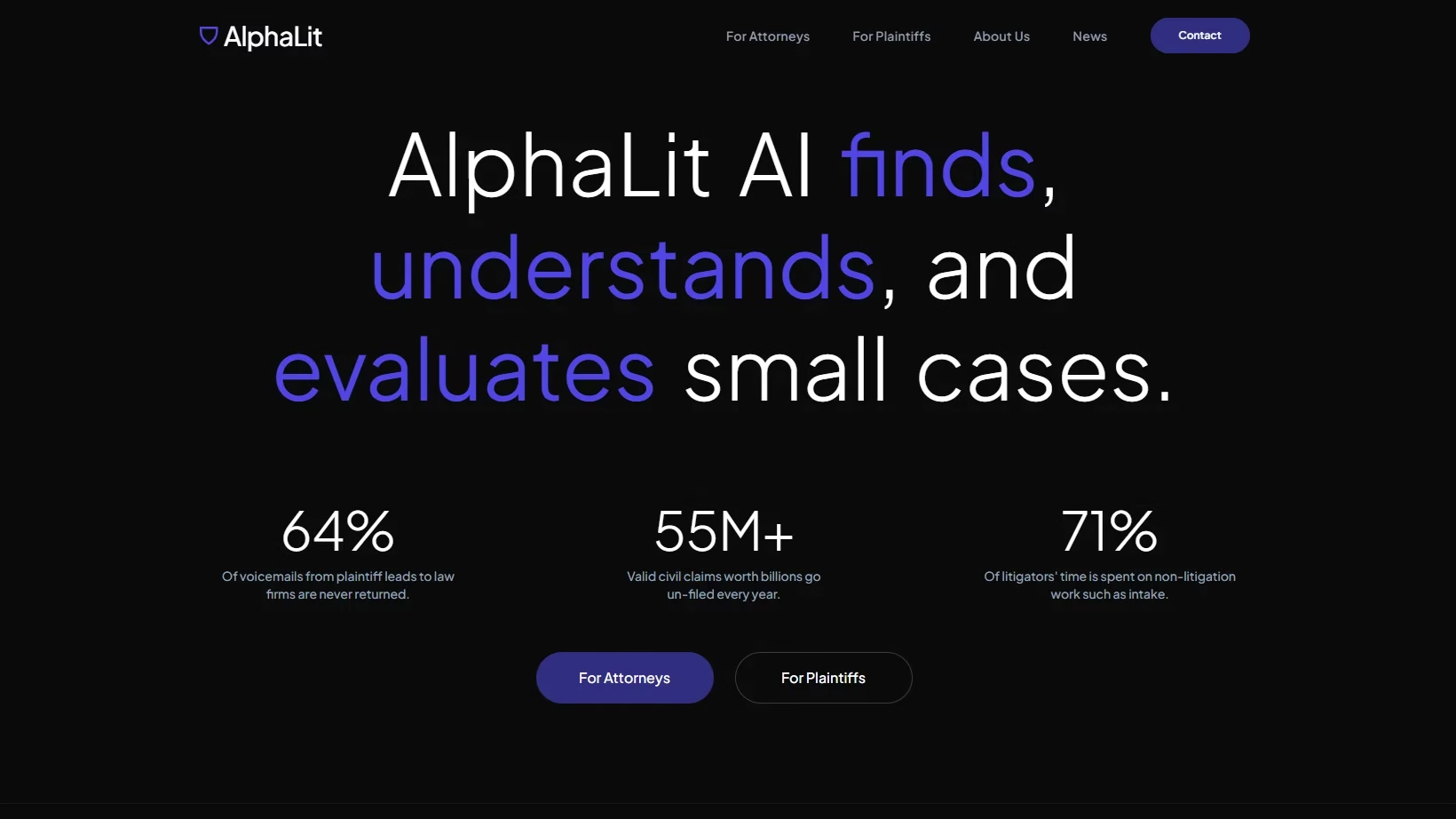
AI Startup AlphaLit Raises $3.2M Seed Round To Screen And Score Smaller Cases And Route Them To Lawyers
AlphaLit’s $3.2 M seed round fuels a voice‑enabled AI platform that predicts low‑value civil claims, offering small law firms cheaper lead generation and higher win rates in 2026.