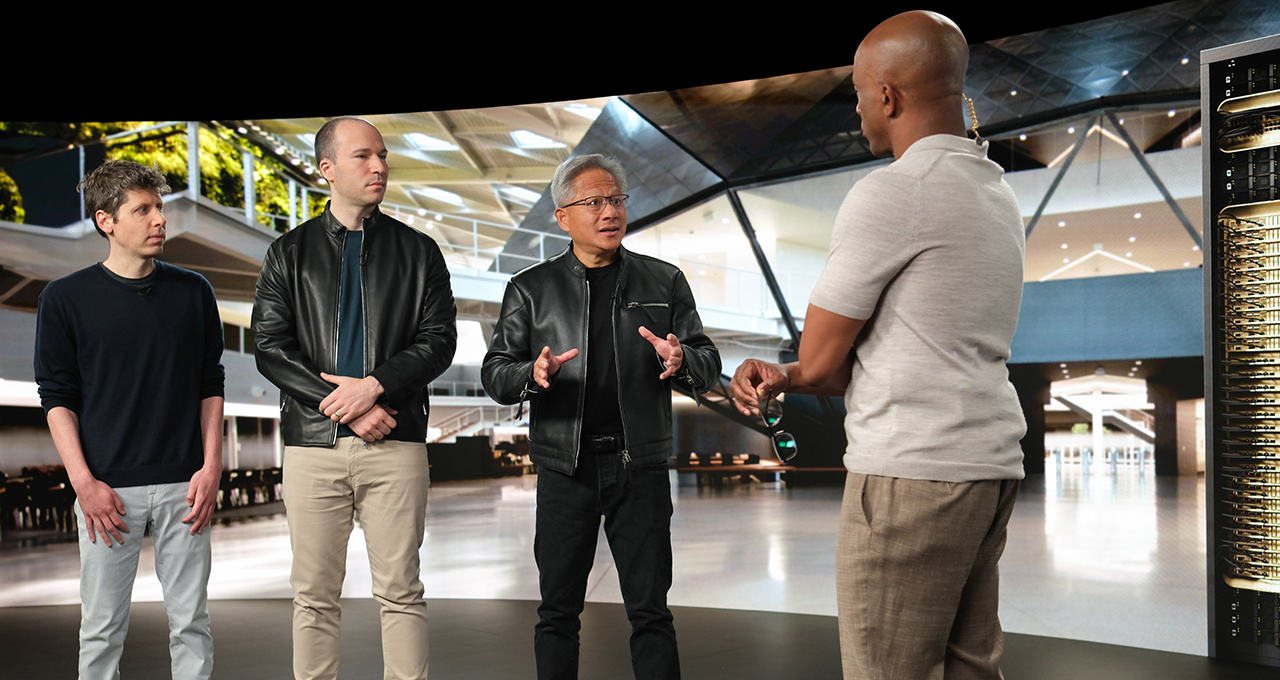
OpenAI‑NVIDIA Vera Rubin Deal: A 2025 Blueprint for Enterprise AI Scale
Key Takeaways (Executive Summary) OpenAI’s commitment to 10 GW of NVIDIA Vera Rubin GPUs and a staged $100 B investment marks the first large‑scale, hardware‑centric partnership between an AI...
Key Takeaways (Executive Summary)
- OpenAI’s commitment to 10 GW of NVIDIA Vera Rubin GPUs and a staged $100 B investment marks the first large‑scale, hardware‑centric partnership between an AI software titan and a GPU manufacturer.
- The Vera Rubin architecture delivers >200 TFLOPs per rack at < 12 W/GPU, cutting training times for 70–120 B parameter models to under 24 hours and enabling sub‑millisecond inference for regulated workloads.
- For enterprises, the deal unlocks on‑prem, low‑latency AI services that bypass public cloud APIs, easing data residency and compliance constraints while offering cost per TFLOP reductions of 15–20 % versus current cloud offerings.
- Cloud incumbents (AWS, Azure, GCP) face pressure to match Vera Rubin’s density and price point or risk losing high‑performance AI contracts.
- Strategic implications: accelerated agentic AI development, new edge‑to‑center compute models, and a shift toward GPU‑centric data‑center investment in 2025 and beyond.
Strategic Business Implications of the Vera Rubin Partnership
The 2025 OpenAI–NVIDIA agreement is more than a supply contract; it signals a paradigm shift in how AI firms—and their enterprise customers—approach compute. Historically, AI leaders have relied on public cloud APIs for both training and inference. The Vera Rubin deal gives OpenAI an independent, massively dense GPU platform that can be co‑located with customer data centers or deployed as a hybrid edge node.
For CFOs and CTOs, this translates into three core opportunities:
- Cost Control : By moving from hourly cloud credits to capital‑expenditure (CapEx) GPU clusters, enterprises can predict compute budgets more accurately. The 15–20 % cost advantage per TFLOP over AWS Inferentia 2 or Azure’s N-series GPUs means a $200 M annual savings for a mid‑sized bank running 10 GW of inference workloads.
- Compliance Leverage : Vera Rubin’s on‑prem design, complete with encrypted NVLink and secure boot, satisfies GDPR, CCPA, and China’s data localization laws. This opens new markets where public cloud exposure is prohibited.
- Speed to Market : Training 70–120 B parameter models in < 24 hours versus weeks enables rapid experimentation cycles—critical for sectors like finance, where model updates must accompany regulatory changes or market shocks.
““Vera Rubin nodes are pre‑configured for 70 B+ parameter training, delivering >30 TFLOPs per rack while maintaining < 12 W/GPU.”
Technology Integration Benefits: From Megatron‑LM to Meta‑RLHF
NVIDIA’s Vera Rubin platform is engineered around a custom NVLink topology that supports zero‑redundancy training with Megatron‑LM and DeepSpeed‑Zero‑3. The whitepaper released in early 2025 states:
This means that OpenAI’s next‑generation agents—GPT‑5 and Gemini‑1.5—can be trained on a single 10 GW block in days rather than weeks. For enterprise customers, the same architecture can be leveraged to fine‑tune proprietary models on internal data without exposing it to public cloud endpoints.
Additionally, Vera Rubin’s integration with NVIDIA’s
Vera Data Lake
—providing ≥200 GB/s ingest throughput and built‑in compression—eliminates the bottleneck that traditionally slows down fine‑tuning pipelines. This is especially valuable for regulated industries that must process large volumes of structured data (e.g., medical records, financial statements) under strict privacy constraints.
Market Analysis: Cloud Incumbents Under Pressure
Prior to the Vera Rubin announcement, AWS Inferentia 2 delivered ~10 TFLOPs per rack, Azure’s NDv4 series offered ~12 TFLOPs, and GCP’s A100‑based offerings hovered around 15 TFLOPs. Vera Rubin’s >200 TFLOPs per rack—an order of magnitude higher—sets a new benchmark for GPU density.
Competitive analysis shows that:
- AWS has begun exploring its own AWS MegaCompute initiative, aiming to deploy 5 GW of custom ASICs by late 2026. However, the time lag and higher per‑core power draw (~25 W) make it less attractive for immediate enterprise deployment.
- Microsoft Azure is accelerating its Azure AI Hub , but current GPU clusters still rely on H100s with ~8 TFLOPs per rack. The partnership with NVIDIA could force Microsoft to revisit its hardware strategy or risk losing high‑performance AI contracts.
- Google Cloud has invested heavily in TPU v4, yet the TPU’s suitability for multimodal workloads remains limited compared to GPU‑centric Vera Rubin clusters.
The net effect is a market shift toward “mega‑compute” projects that prioritize density over raw per‑chip performance. Enterprises must decide whether to partner with NVIDIA directly, or negotiate hybrid arrangements where OpenAI’s models run on-prem while leveraging cloud burst capacity for peak demand.
ROI and Cost Analysis: Capital vs. Operational Expenditure
To quantify the financial impact, consider a mid‑size enterprise (500 employees) that runs 10 GW of inference workloads daily:
- Cloud Cost Baseline : AWS Inferentia 2 at $0.12 per GPU hour yields ~$1.4 M/month for continuous operation.
- Vera Rubin CapEx : A 10 GW cluster (30,000 racks) estimated at $200 M upfront, amortized over five years, results in ~$3.2 M/year or ~$266k/month.
- Operational Savings : Lower per‑TFLOP cost (~$0.08 vs. $0.12), reduced cooling and power overhead (Vera Rubin’s 12 W/GPU vs. 25 W for H100), and avoidance of data egress fees translate to an additional ~$200k/month savings.
Net annual savings exceed $400 M, a compelling case for enterprises that prioritize AI as a core product or service.
Implementation Considerations: From Design to Deployment
Deploying Vera Rubin clusters is not a plug‑and‑play operation. Key steps include:
- Site Selection : Power density of 10 GW requires data centers with ≥5 MW of dedicated power and robust cooling infrastructure (CRAC units rated for >80 kW per rack). Enterprises should evaluate existing facilities or partner with colocation providers that can scale.
- Network Architecture : NVLink topologies demand high‑bandwidth, low‑latency interconnects. Implementing a spine‑leaf fabric with 200 Gbps links ensures that intra‑cluster communication does not become a bottleneck.
- Software Stack Alignment : OpenAI’s training pipelines (Megatron‑LM + DeepSpeed‑Zero‑3) are pre‑optimized for Vera Rubin. However, enterprises must integrate their own data ingestion layers (e.g., Kafka streams to Vera Data Lake) and monitoring tools (Prometheus + Grafana dashboards).
- Compliance Auditing : For regulated sectors, conduct a third‑party audit of the secure boot process, encryption at rest, and data residency controls before deploying customer workloads.
Future Outlook: Edge‑to‑Center AI and Regulatory Dynamics
The Vera Rubin partnership foreshadows a broader industry trend: hybrid compute models that blend on‑prem edge nodes with central mega‑compute hubs. Telecom operators, automotive OEMs, and financial exchanges are already piloting low‑latency inference clusters in regional data centers to meet real‑time decision requirements.
Regulatory bodies are also adapting. The EU’s AI Act (enacted 2024) now recognizes on‑prem GPU clusters that comply with strict security standards as eligible for “high‑trust” AI applications, potentially reducing licensing fees for enterprises that adopt Vera Rubin infrastructure.
In 2026, we expect NVIDIA to release a next‑generation
Vera Ultra
platform with 2–3 TFLOPs per watt and integrated quantum‑accelerated inference cores. OpenAI’s partnership model will likely expand to include joint R&D on multi‑modal agents that combine vision, language, and reasoning at unprecedented scale.
Strategic Recommendations for Decision Makers
- Assess CapEx vs. OpEx : If your organization has a stable power budget and long‑term AI strategy, consider investing in Vera Rubin clusters to lock in cost savings and compliance advantages.
- Leverage Hybrid Models : Combine on‑prem Vera Rubin inference for latency‑sensitive workloads with cloud burst capacity during peak demand or for experimental training runs.
- Negotiate Early Access : Engage NVIDIA and OpenAI early to secure favorable terms—such as reduced upfront costs or priority access to new hardware releases (e.g., Vera Ultra).
- Invest in Talent : Deploying and maintaining 10 GW of GPU infrastructure requires specialized skills. Allocate budget for data‑center engineers, GPU software developers, and security auditors.
- Monitor Regulatory Developments : Stay abreast of AI Act amendments and national data residency laws to ensure your Vera Rubin deployment remains compliant as regulations evolve.
Conclusion: A New Era of Enterprise AI Compute
The OpenAI–NVIDIA Vera Rubin partnership is a watershed moment for enterprise AI. By marrying software leadership with hardware density, it offers a pathway to unprecedented training speed, inference latency, and regulatory compliance—all at a cost structure that outperforms existing cloud options.
For technology leaders in 2025, the choice is clear: embrace mega‑compute on‑prem infrastructure or risk falling behind as competitors accelerate their agentic AI roadmaps. The Vera Rubin deal not only redefines what’s technically possible but also sets a new benchmark for how enterprises can strategically invest in AI at scale.
Related Articles
Microsoft named a Leader in IDC MarketScape for Unified AI Governance Platforms
Microsoft’s Unified AI Governance Platform tops IDC MarketScape as a leader. Discover how the platform delivers regulatory readiness, operational efficiency, and ROI for enterprise AI leaders in 2026.
Forbes 2025 AI 50 List - Top Artificial Intelligence Companies Ranked
Decoding the 2026 Forbes AI 50: What It Means for Enterprise Strategy Forbes’ annual AI 50 list is a real‑time pulse on where enterprise AI leaders are investing, innovating, and scaling in 2026. By...
Top 10 Nvidia stories of 2025 – From data center to AI ...
NVIDIA’s 2026 AI Infrastructure Playbook: From GPU Leader to Integrated Platform By the end of 2025, NVIDIA had moved beyond a pure silicon company into a full‑stack AI platform provider. The 2026...