AI Daily Post - Your Daily AI News in 5 Minutes
Gemini Flash, Reasoning‑First LLMs and the New Pricing Playbook: What 2025 Business Leaders Must Know By Casey Morgan, AI News Curator at AI2Work Executive Snapshot Fast‑Free Baseline: Google’s...
Gemini Flash, Reasoning‑First LLMs and the New Pricing Playbook: What 2025 Business Leaders Must Know
By Casey Morgan, AI News Curator at AI2Work
Executive Snapshot
- Fast‑Free Baseline: Google’s Gemini 3 Flash is now the default, zero‑cost model delivering sub‑second responses with chain‑of‑thought reasoning.
- Reasoning as a KPI: Benchmarks are shifting from perplexity to human preference and internal thought traces; Gemini 2.5 Pro tops LMArena and coding/math leaderboards.
- Pricing Tiers Recalibrated: Free tier at $0.50/1M input tokens, premium tiers drop sharply for high‑volume usage ($0.30/1M over 200k tokens).
- Rapid Release Cadence: Bi‑monthly updates mean infrastructure teams must adopt continuous training pipelines.
- Strategic Opportunity: Enterprises can layer compliance, analytics, or domain fine‑tuning on top of the free core to create differentiated SaaS products.
Market Impact Analysis
The 2025 AI landscape has pivoted around two axes:
speed and cost neutrality
, driven by Gemini Flash; and
reasoning depth
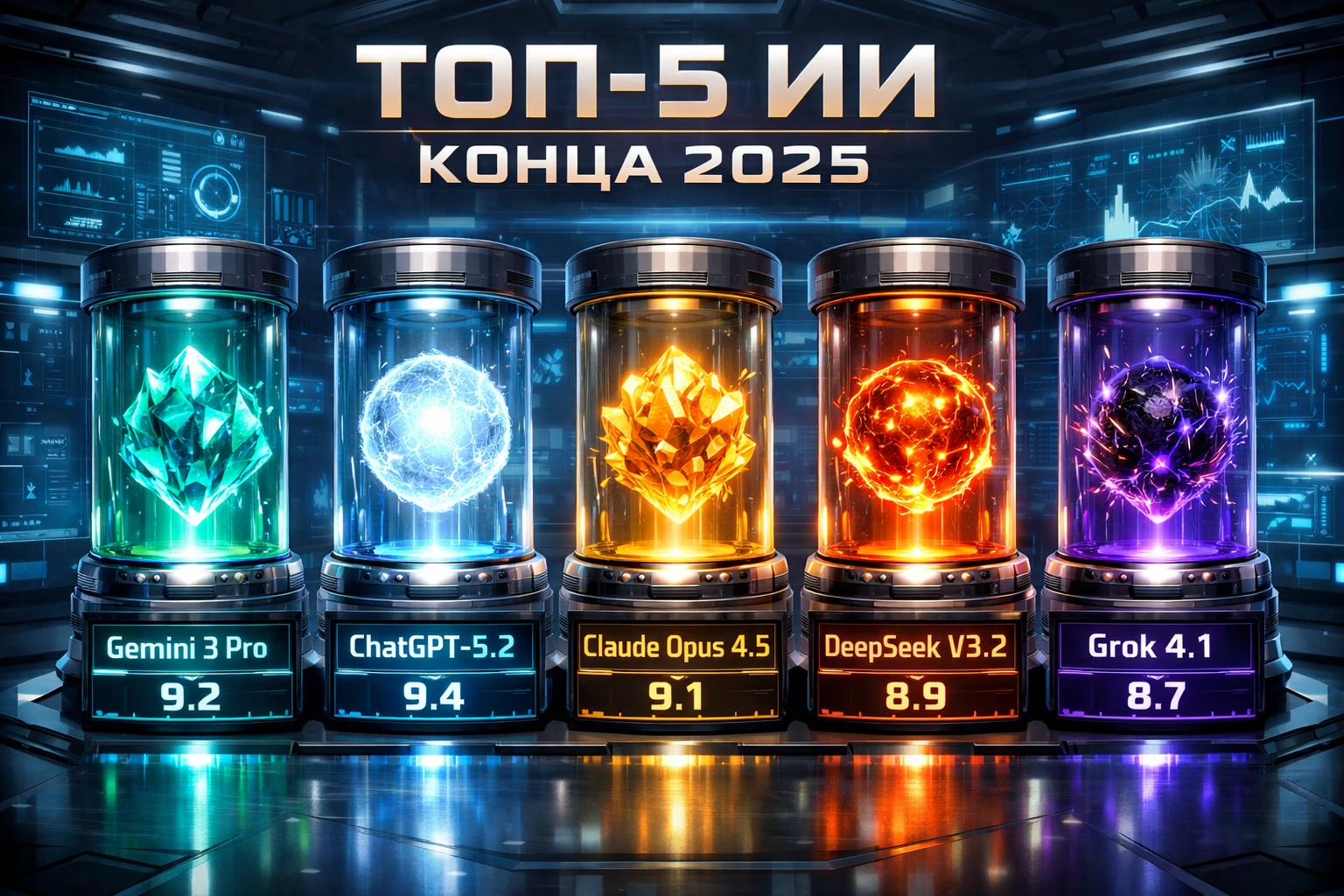
, embodied in chain‑of‑thought (CoT) capabilities across all Gemini generations. Competitors—OpenAI’s GPT‑5.2, Anthropic’s Claude Opus 4.5, Microsoft’s Azure OpenAI offerings—are scrambling to match this dual promise.
For business leaders, the immediate implication is a
lower barrier to entry
. Applications that once required paid LLM subscriptions can now prototype on a free, high‑performance model, accelerating time‑to‑market. However, enterprises must anticipate a
price squeeze
on premium tiers as customers migrate to the flash tier for volume use cases.
In practice, this means reevaluating budgeting models: instead of forecasting per‑token costs at $4–$12/1M (as with GPT‑5.2), you now face a spectrum from $0.50/1M on the free tier to $4/1M on premium, but with significant discounts beyond 200k tokens.
Technical Implementation Guide for Enterprise Teams
Deploying Gemini Flash at scale requires attention to three key areas: API integration, token management, and reasoning orchestration.
API Integration Best Practices
- Endpoint Selection: Use the /v1/flash endpoint for low‑latency calls; switch to /v1/pro when you need deeper context or higher token limits.
- Batching Strategy: Gemini Flash handles up to 200k tokens per request. For workloads exceeding this, implement chunking with a sliding window and merge responses client‑side.
- Retry Logic: Google’s API supports exponential backoff; configure max_retries=5 to handle transient throttles without sacrificing throughput.
Token Management for Cost Control
Because the free tier charges $0.50/1M input tokens, optimizing token usage can save up to 70% on a high‑volume project. Techniques include:
- Prompt Compression: Leverage prompt_embedding modes that reduce prompt length by 30–40% without losing semantics.
- Response Truncation: Use the max_output_tokens parameter to cap output length; set realistic limits (e.g., 256 tokens for FAQs).
- Token Budgeting Dashboard: Build an internal dashboard that tracks token spend per microservice, alerting when thresholds are breached.
Reasoning Orchestration
The new CoT feature is not just a novelty; it’s becoming the standard for complex problem solving. To harness it effectively:
- Enable CoT Flag: Set "reasoning": "chain_of_thought" in your request payload.
- Interpret Output: The model returns a structured JSON with thoughts , actions , and final_answer . Parse these fields to build explainable workflows.
- Human‑in‑the‑Loop (HITL): For regulated industries, expose the thoughts field in dashboards so auditors can review the reasoning path.
Strategic Recommendations for Product Managers
Gemini Flash’s dominance forces a shift from “feature‑centric” to “value‑layered” product strategies. Here are three actionable pathways:
1. Build SaaS Layers on Top of the Free Core
- Compliance Plug‑Ins: Embed GDPR, HIPAA, or PCI checks that wrap Gemini responses before delivery.
- Domain Fine‑Tuning: Offer industry‑specific adapters (legal, medical, finance) that fine‑tune the base model with proprietary corpora.
- Analytics Dashboards: Provide usage metrics, sentiment analysis, and conversation heatmaps to customers.
2. Leverage Reasoning for Competitive Differentiation
- Explainable AI Features: Highlight the CoT output in your UI to build trust with skeptical stakeholders.
- Automated Decision Support: Use the reasoning chain to generate audit trails, improving adoption in regulated sectors.
- Hybrid Models: Combine Gemini’s reasoning layer with GPT‑5.2 for niche tasks (e.g., creative writing) while keeping core logic on Gemini.
3. Optimize Cost Through Token Economy
- Token Pooling: Aggregate multiple user queries into a single batch to reduce per‑token overhead.
- Dynamic Tier Switching: Automatically route high‑volume requests to the flash tier and reserve pro tier for low‑latency, high‑context needs.
ROI Projections: Free Tier vs. Premium Spend
A quick cost comparison illustrates the upside of adopting Gemini Flash as a baseline:
Model
Token Cost (per 1M)
Typical Use Case
Gemini Flash (Free Tier)
$0.50
Customer support chatbots, FAQ generators
Gemini Pro
$4.00
Enterprise knowledge bases, internal tooling
GPT‑5.2 (Standard)
$12.00
Advanced analytics, content creation
Assuming a medium‑sized firm processes 10 million tokens monthly for chatbots, the cost saving with Gemini Flash is roughly $4,950 per month compared to GPT‑5.2—an annual savings of nearly $60k.
Implementation Roadmap: From Ideation to Production
- Proof of Concept (Week 1–2): Build a minimal chatbot using Gemini Flash; measure latency and token usage.
- Cost Modeling (Week 3): Simulate high‑volume scenarios with token budgeting dashboards.
- Compliance Layering (Month 1–2): Integrate audit trails for CoT output; conduct internal compliance review.
- Scaling (Month 3+): Deploy on Kubernetes with autoscaling based on request volume; monitor GPU/TPU utilization.
- Monetization Layer (Quarter 2): Offer premium add‑ons (domain fine‑tuning, analytics) to existing customers.
Future Outlook: Reasoning Everywhere and the Next Generation of LLMs
DeepMind’s commitment to embed CoT in all future Gemini models signals a broader industry trend: reasoning will become the default expectation. This has several cascading effects:
- Explainability Demand: Regulators and users alike will require transparent reasoning traces; businesses that can surface these will gain trust.
- Hardware Evolution: Reasoning layers increase internal state, potentially necessitating more powerful GPUs or specialized ASICs to maintain low latency.
- Model Governance: Enterprises must develop governance frameworks that capture and audit reasoning outputs, especially in high‑stakes domains.
Key Takeaways for Decision Makers
- Gemini Flash is the new baseline—free, fast, and reasoning‑capable. Leverage it to prototype quickly and cut token costs.
- Premium tiers are still valuable for high‑context or regulated use cases but will see price pressure from high-volume free usage.
- Reasoning (CoT) is now a performance metric; integrate explainability into your product roadmap to meet customer expectations.
- Build SaaS layers—compliance, analytics, domain fine‑tuning—on top of the free core to create differentiated revenue streams.
- Adopt continuous training pipelines and token budgeting dashboards to keep pace with bi‑monthly release cycles.
Strategic Recommendations for 2025 AI Adoption
- Audit Your Token Footprint: Map out all LLM usage, calculate current spend, and identify opportunities to shift to Gemini Flash.
- Create a Reasoning Layer Strategy: Decide whether you’ll expose CoT output in your UI or keep it internal for compliance purposes.
- Develop a Monetization Playbook: Outline SaaS add‑ons that complement the free core—compliance, analytics, domain expertise.
- Invest in Infrastructure Agility: Build CI/CD pipelines that can deploy new model versions within weeks, not months.
- Prepare for Hardware Scaling: Evaluate whether your current GPU fleet supports the increased inference times of reasoning‑rich models.
In 2025, the AI landscape is no longer a race to build larger models; it’s a race to deliver
fast, free, and explainable intelligence at scale
. By aligning your strategy around Gemini Flash’s capabilities and the emerging emphasis on reasoning, you can unlock significant cost savings, accelerate innovation, and position your organization for sustained competitive advantage.
Related Articles

Anthropic launches Claude Cowork, a version of its coding AI for regular people
Explore Claude Cowork, Anthropic’s no‑code AI agent launching in 2026—boosting desktop productivity while keeping data local.

Google Releases Gemma Scope 2 to Deepen Understanding of LLM Behavior
Gemma Scope 2: What Enterprise AI Leaders Need to Know About Google’s Rumored Diagnostic Suite in 2026 Meta‑description: Explore the latest evidence on Gemma Scope 2, Google’s alleged LLM diagnostic...

The 10 Biggest AI News Stories Of 2025 - CRN
A deep dive into the current 2026 enterprise AI landscape—Gemini 1.5 on Google Cloud, Claude 3.5 Sonnet via Anthropic’s gateway, OpenAI’s o1‑preview—and how to align performance, compliance, and prici