
AI coding startup Lovable CEO envisions AGI as software system; eyes founder-led hiring push for 2026
Discover how Lovable’s AGI-as‑Software strategy, LLM orchestration, and founder‑led talent are reshaping the non‑developer market. Read the 2026 outlook for funding, hiring, and competitive positionin
Lovable AI SaaS: Building a System‑Centric AGI Platform in 2026
Executive Snapshot
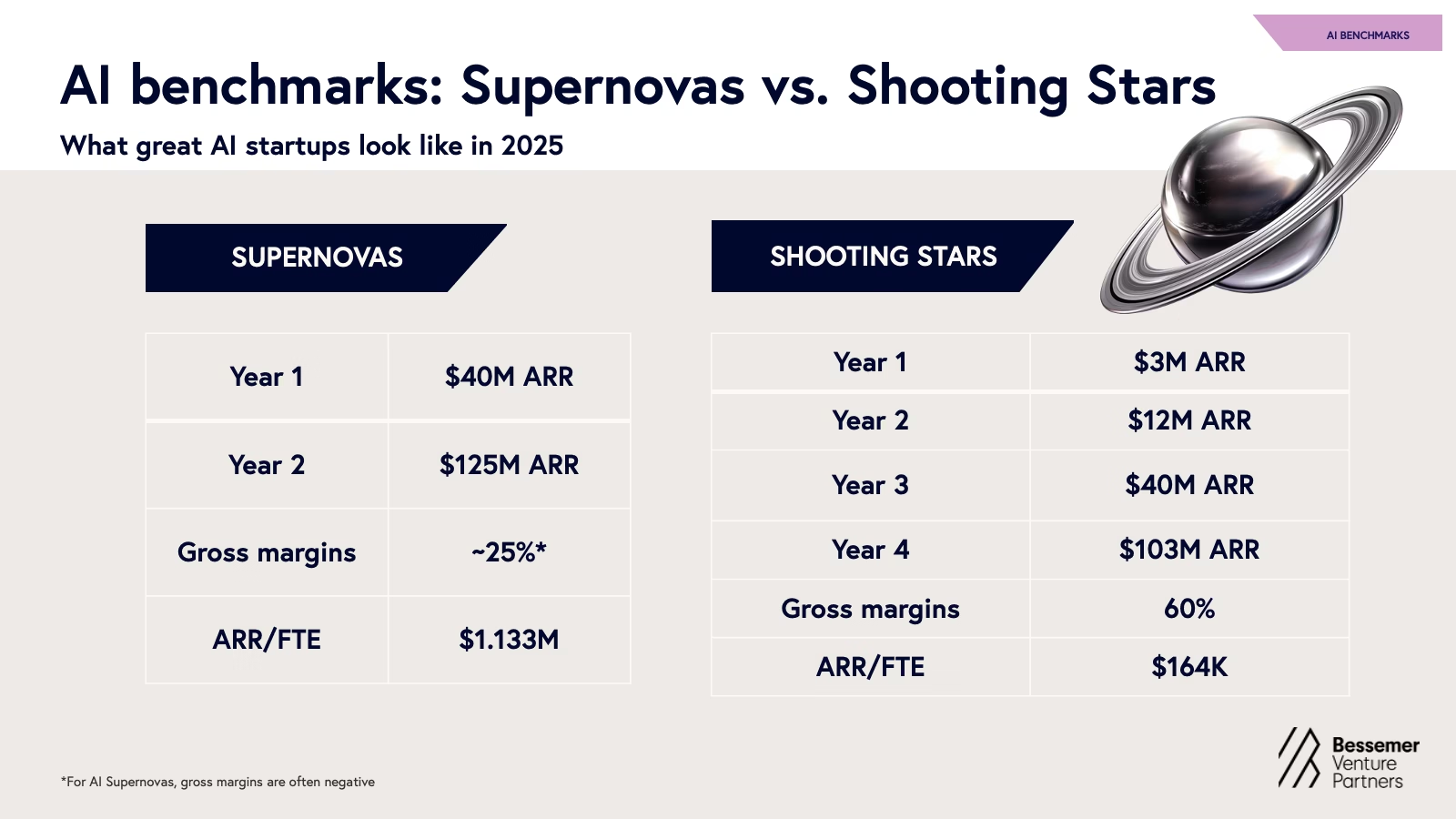
- Lovelace, founded by Anton Osika, has surpassed $100 M ARR within eight months of launch.
- The company closed a $330 M Series A in December 2025, valuing it at $6.6 B—an early‑stage valuation that reflects projected 2026 traction.
- Lovable redefines AGI as an orchestrated system , not a single model, and is actively recruiting founder‑led talent for its Stockholm hub in 2026.
- The platform translates plain‑language prompts into production‑ready code for non‑developers, positioning it ahead of GitHub Copilot and Cursor.
- Its strategy hinges on LLM orchestration (GPT‑4o, Gemini 3 Flash, Claude Sonnet 4.5) rather than proprietary model ownership.
This article examines Lovable’s funding architecture, business model evolution, hiring philosophy, technical stack, competitive landscape, and projected 2026–2027 outlook—providing actionable insights for founders, VCs, and product leaders.
Funding Architecture in the 2026 Landscape
- Revenue‑First Capital Deployment – Lovable’s ARR growth demonstrates that early revenue can be generated through product‑first AI services , reducing pressure for breakthrough patents before Series A.
- Runway‑First VC Preference – In 2026, investors prioritize companies with a clear path to profitability within 12–18 months post‑funding. The $330 M raise aligns with this trend, allowing capital to focus on system integration rather than raw model training.
- Future Rounds Focus – Subsequent funding will target scaling infrastructure (cloud orchestration, API gateways) and partner ecosystems (integration with CI/CD tools), not new research.
Business Model Evolution for AGI‑as‑Software
- Freemium‑to‑Enterprise Ladder – Basic code generation is offered at $10/month per user, while an enterprise tier delivers advanced orchestration and analytics at $200/month per seat.
- Subscription & Usage Monetization – “Meta‑learning” modules that auto‑optimize code can be sold as premium add‑ons. Enterprise licensing, data‑as‑a‑service (curated fine‑tuning datasets), and white‑label APIs broaden revenue streams.
- Revenue Diversification Pathway – By 2027, Lovable aims to capture >30% of its ARR from enterprise contracts and professional services.
Founder‑Led Talent: A Competitive Edge
Lovelace’s hiring strategy focuses on former startup founders who bring:
- Rapid iteration mindset and risk tolerance.
- Product intuition that guides AI pipeline design toward real business problems.
- Expertise in leveraging cloud‑agnostic LLMs, reducing GPU dependence.
Technical Architecture: Multi‑Modal LLM Orchestration
- Layered Prompt Engine – GPT‑4o handles natural language understanding; Gemini 3 Flash performs reasoning; Claude Sonnet 4.5 synthesizes code.
- Microservices & Autoscaling – Kubernetes pods auto‑scale based on API usage, ensuring cost efficiency.
- Meta‑Learning Loop – RLHF and user feedback continuously refine prompt engineering, improving accuracy over time.
- Data Governance – Zero‑trust architecture with end‑to‑end encryption and differential privacy safeguards sensitive prompts.
Market Positioning Against Competitors
- Vibe‑Coding Gap – Unlike GitHub Copilot, Lovable eliminates the developer skill barrier, targeting a 10–12 M non‑developer user base with an average spend of $500/year.
- Defensive Moat – Proprietary orchestration logic and an engaged community of power users create network effects that are hard for incumbents to replicate quickly.
- Strategic Partnerships – Embedding Lovable’s code generation in low‑code platforms (e.g., Bubble, Webflow) expands reach without direct competition.
Financial Projections and ROI 2026–2027
Metric
2026 Estimate
ARR (Base Tier)
$600 k
ARR (Enterprise Tier)
$2.4 M
Total ARR
$3 M
Operating Expenses
$2.4 M
Margin
20%
User Base (Projected 18‑Month)
50 k paying users
Breakeven ARR
$10 M
Implementation Roadmap for Investors and Founders
- Phase 1 (0–6 mo) : Core orchestration platform; beta with SaaS product managers.
- Phase 2 (6–12 mo) : Enterprise tier launch; dedicated sales team targeting fintech, healthtech, e‑commerce.
- Phase 3 (12–24 mo) : Meta‑learning module release; data‑as‑a‑service offerings; research into multi‑modal reasoning engines.
Strategic Recommendations
- Founders: Build a robust API layer for third‑party consumption, invest early in data governance, and leverage founder talent for product strategy.
- VCs: Verify runway and revenue model; assess system maturity through modular architecture and performance benchmarks.
- Product Managers: Map your roadmap to Lovable’s API capabilities; use meta‑learning modules to accelerate feature delivery; monitor adoption metrics for prioritization.
Projected 2026–2027 Outlook
In 2026, the AI SaaS ecosystem continues to shift from model ownership toward system integration. Lovable’s founder‑led hiring push and LLM orchestration give it a speed advantage over incumbents. By 2027, the company aims to expand beyond non‑developers into enterprise AI engineering teams, potentially unlocking valuation multiples comparable to early‑stage AI leaders.
Key Takeaways
- Funding should prioritize system integration over raw model training.
- Founder talent accelerates experimentation and product‑market fit.
- The non‑developer market offers a sizable, underserved opportunity.
- Multi‑modal LLM orchestration creates a defensible moat against incumbents.
- Diversifying revenue streams into enterprise licensing and professional services boosts ROI.
Actionable next steps:
- Founders: audit talent pipelines for founder experience.
- VCs: evaluate Lovable’s system architecture and runway.
- Product teams: prototype with the platform’s API today to unlock future growth.
Related Articles

AI Startups Raise Record $150B in 2025 , Redefining Venture ...
Explore how the $150 B AI funding wave of 2025–26 reshapes startup strategy. Learn about cost‑efficiency models, agent reliability, compliance, and investment outlook for enterprise AI leaders in 2026

Inside Thinking Machines Lab, Mira Murati’s New AI Startup | Built In
Explore how Thinking Machines Lab’s record‑sized seed round is poised to democratize fine‑tuning, lower AI costs, and shift funding toward talent. Technical insights for enterprise leaders.
Where VCs think AI startups can win, even with OpenAI in the game | TechCrunch
Explore the Consumer‑AI Growth Strategy 2026—key funding trends, modular architecture, retention metrics, and data‑sovereignty tactics that early‑stage founders need to win VC capital.