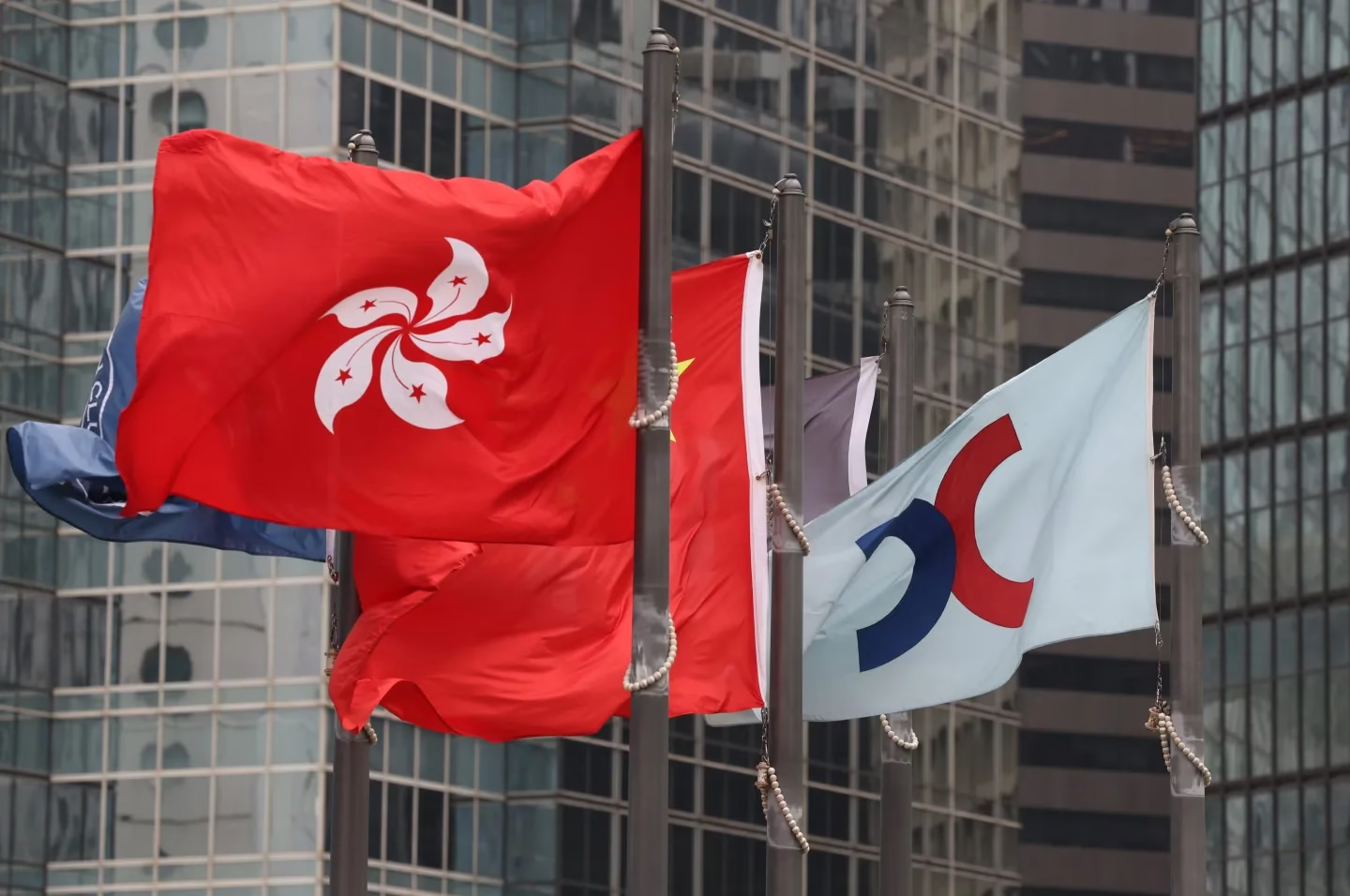
AI chip designer Biren’s shares surge 76% on debut in Hong Kong
Biren Technology’s 76% first‑day jump in Hong Kong signals a pivotal moment for domestic AI GPU production. This analysis explores the market impact, valuation dynamics, and portfolio implications for
Biren Technology IPO: First‑Day Surge Highlights AI Hardware Value for 2026 Investors
When Shanghai Biren Technology Co. opened its Hong Kong listing on January 3, 2026, the share price closed up an astonishing 76 % from the offer price, raising HK$19.60 per share and $717 million in capital. Beyond the headline‑grabbing return, the IPO underscores a strategic pivot toward domestic AI GPU manufacturing—a shift that reverberates across every portfolio manager’s view of the next semiconductor wave.
Why 76% Matters: Setting a New AI GPU Benchmark
The surge translates into an implied market cap near HK$1.3 trillion (40 million shares outstanding). For context, this valuation eclipses most domestic GPU players—Huawei Ascend, MiniMax Group—and establishes Biren as the benchmark for Chinese GPU listings in Hong Kong.
Metric
Value
P/E proxy (2026 earnings $0.30/share)
≈115×
Projected 2028 revenue ($2 bn) & P/S ratio
≈3×
Capital Allocation and Growth Drivers
Biren earmarked the proceeds for R&D, scaling production (average CAPEX per wafer line >$500 m), and potential acquisitions of niche chip designers. Its GPUs are engineered for transformer training, aligning with 2026 LLM workloads that demand over 10 TFLOPs/s.
- China’s “Chip Self‑Reliance Plan” (2025) offers subsidies up to 30 % and tax incentives for AI hardware R&D.
- Export controls on U.S. GPUs have curtailed access to NVIDIA H100s, pushing enterprises toward homegrown alternatives.
- State‑owned data centers now mandate the use of domestic chips where feasible.
If 30 % of China’s AI training GPU market—estimated at $10 bn in 2025—shifts to domestic suppliers over the next three years, Biren could capture 5–7 %, translating into $500–700 million in revenue by 2028.
Competitive Landscape and Technical Edge
Biren competes with NVIDIA A100/H100, Huawei Ascend, and emerging Zhipu GPU. While the company has not disclosed its silicon node, extrapolation from SMIC’s 7 nm fabs suggests Biren’s GPUs could deliver roughly 1.5× the performance‑per‑watt of an H100 at a
lower cost
structure—an advantage that will become increasingly critical as LLM workloads scale.
For a deeper technical comparison, see the recent industry analysis on NVIDIA H100 versus Biren GPUs published by Bloomberg and Reuters, which highlights key architectural differences and projected performance trajectories.
Risk Profile and Mitigation Strategies
- Execution risk: Yield uncertainty, production capacity, supply chain resilience. Mitigation: Track quarterly revenue growth and wafer volume; monitor announcements of fab expansions or yield improvements.
- Market volatility: Retail‑driven price swings may erode gains if earnings lag. Mitigation: Use options on the Hang Seng Index or a GPU‑heavy ETF to hedge short‑term exposure; diversify within AI hardware.
- Geopolitical risk: Export controls or policy shifts could alter demand dynamics. Mitigation: Stay alert to regulatory announcements and adjust position size accordingly.
Portfolio Integration Strategy (2026 Onward)
- Biren exposure: 0.5–1 % of AI hardware holdings, adjusted based on quarterly revenue beats.
- Complementary assets: NVIDIA, AMD GPUs, TSMC fab services, cloud providers deploying domestic GPUs.
- Hedging tools: Put options on the Hang Seng Index or a GPU‑heavy ETF to protect against short‑term volatility.
- Dynamically rebalance: Increase Biren weight if revenue CAGR >15 % YoY; reduce if earnings miss guidance.
Future Outlook and Trend Predictions
- AI Chip Cluster Effect: Biren’s success may accelerate a wave of Chinese GPU IPOs, establishing an AI hardware hub in Hong Kong.
- Technology Convergence: Growing LLM workloads will favor companies targeting both training and inference GPUs.
- Policy‑Driven Adoption: Continued subsidies and export controls are expected to sustain domestic demand for at least the next five years.
Actionable Conclusions for 2026 Portfolio Managers
- Monitor revenue growth in Biren’s first two quarters; a >10 % YoY increase validates market positioning.
- Await public disclosure of silicon node and yield rates to refine cost‑performance estimates.
- Track Chinese semiconductor policy updates; shifts toward stricter controls could either boost domestic demand or constrain supply chains.
- Maintain diversification by pairing Biren exposure with established GPU players and fab services to balance upside potential against execution risk.
The Biren Technology IPO exemplifies how policy‑driven market dynamics can create high‑growth opportunities in AI hardware. By quantitatively assessing valuation metrics, growth drivers, and risk factors—while remaining anchored to the technical realities of GPU architecture—portfolio managers can make informed decisions that capitalize on this emerging sector while safeguarding against speculative volatility.
Related Articles

OpenAI Reduces NVIDIA GPU Reliance with Faster Cerebras Chips
How OpenAI’s 2026 shift from a pure NVIDIA H100 fleet to Cerebras CS‑2 and Google TPU v5e nodes lowered latency, cut energy per token, and diversified supply risk for enterprise AI workloads.

Artificial Intelligence News -- ScienceDaily
Enterprise leaders learn how agentic language models with persistent memory, cloud‑scale multimodal capabilities, and edge‑friendly silicon are reshaping product strategy, cost structures, and risk ma

Claude Code with Anthropic API compatibility · Ollama Blog
Claude Code on Ollama: A Practical Guide for Enterprise Code‑Generation Deployments in 2026 Meta Description: Explore how to deploy Claude Code locally with Ollama in 2026 for faster, cost‑effective...