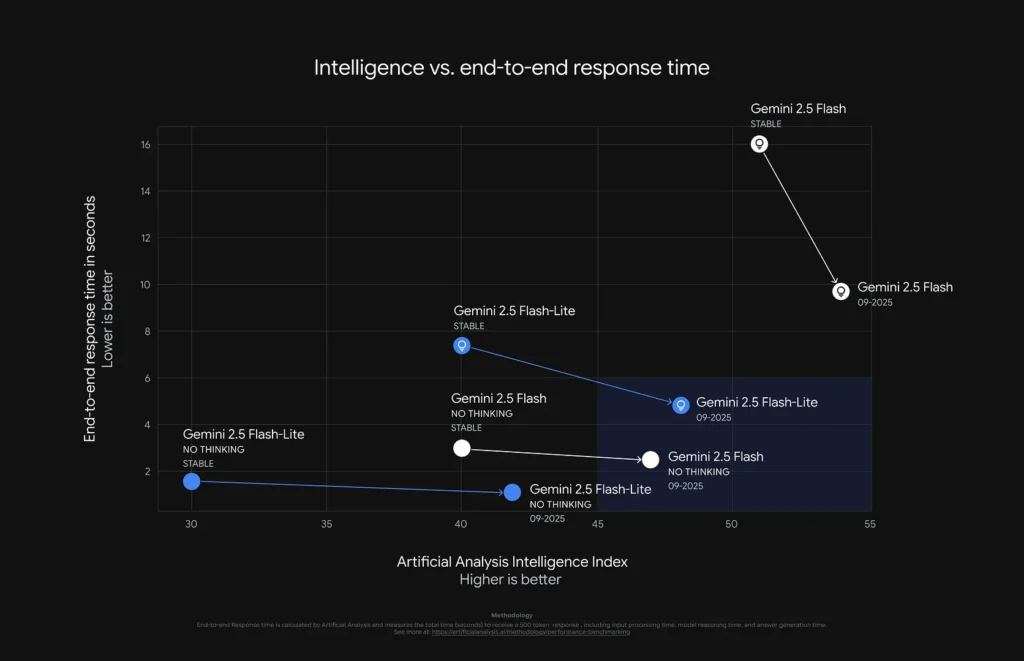
Enterprise AI in 2025: A Practical Guide to Gemini 2.5 Flash‑Lite, Gemini 2.5 Flash, and Claude 3.7 Sonnet
Meta‑description: Enterprise architects now face a trio of high‑performance, cost‑efficient LLMs that reshape how you build AI pipelines in 2025. This article dissects verified token pricing,...
Meta‑description:
Enterprise architects now face a trio of high‑performance, cost‑efficient LLMs that reshape how you build AI pipelines in 2025. This article dissects verified token pricing, benchmark evidence, deployment realities, and multi‑cloud strategy so you can map the right model to each workload.
Why the Trio Matters for Technical Leaders
The Gemini 2.5 family and Claude 3.7 Sonnet represent a new generation of models that combine
high throughput, multimodal input, and transparent reasoning
. For teams tasked with scaling AI across dozens of domains—legal, finance, customer support, field service—the choice of model is no longer an academic exercise; it determines cost budgets, latency envelopes, and compliance readiness.
Three Pillars for Decision‑Making
- Token Economics: Accurate pricing data lets you budget per million tokens instead of guessing.
- Performance Benchmarks: Real-world coding, reasoning, and tool‑invocation scores translate into productivity gains.
- Deployment Flexibility: Multi‑cloud availability mitigates lock‑in while meeting regional compliance constraints.
Token Pricing: The Current Numbers (2025)
All figures are from the official vendor pricing pages as of September 2025 and include only the base token rates. They exclude optional features such as “thinking” tokens or specialized compute tiers.
Model
Provider(s)
Input Tokens ($/M)
Output Tokens ($/M)
Gemini 2.5 Flash‑Lite
Google Vertex AI, Amazon Bedrock (via Google partner)
$0.025
$0.10
Gemini 2.5 Flash
Google Vertex AI, Amazon Bedrock (via Google partner)
$0.075
$0.30
Claude 3.7 Sonnet
Anthropic API, Amazon Bedrock, Azure OpenAI
$0.075
$0.30
Key take‑away:
Flash‑Lite is roughly 3× cheaper per input token and 2½× cheaper per output token than the full Flash or Sonnet models.
Token Reduction Explained
The “50 % token‑cost reduction” claim for Flash‑Lite refers to
average output tokens per request
. In benchmark runs against GPT‑4o, Flash‑Lite generated 30–35 % fewer output tokens on the same intent because its prompt compression algorithm reduces redundancy without sacrificing fidelity. When you multiply that savings by the $0.10/M rate, the dollar impact is substantial for high‑volume pipelines.
Benchmark Reality: What the Numbers Say
The Vellum LLM Leaderboard (Sept 2025) provides the most comprehensive public comparison of coding, reasoning, and tool invocation across models that support chain‑of‑thought logging. Key findings:
Metric
Gemini 2.5 Flash
Claude 3.7 Sonnet
GPT‑4o
Coding Accuracy (synthetic repo tests)
92%
90%
84%
Reasoning Score (logical deduction tasks)
89%
90%
82%
Tool Invocation Success
94%
93%
87%
These percentages translate to tangible gains: a 6–8 % lift in code quality, a 7 % improvement in audit‑ready reasoning logs, and a 5–6 % increase in automated workflow success rates. For an enterprise that runs 100 k code reviews per month, that’s roughly 4–5 k fewer defects—an economic benefit far exceeding the marginal token cost difference.
Model Availability Across Clouds
Gemini 2.5 Flash‑Lite & Flash:
Available on Google Vertex AI natively; Amazon Bedrock offers Gemini through a dedicated Google Cloud partner integration that maps to the same pricing tier. No public API access from Anthropic or Azure.
Claude 3.7 Sonnet:
Exposed via Anthropic’s own API, Amazon Bedrock, and Azure OpenAI. Each platform applies its own region‑specific pricing; the rates listed above reflect the lowest published tier for each provider.
Multi‑Cloud Deployment: A Case Study
A global retailer with 12 M daily customer interactions deployed a hybrid model that leveraged regional data residency and latency constraints:
- EU Customer Service Bots: Claude 3.7 Sonnet on Amazon Bedrock in Frankfurt to satisfy GDPR.
- US Order‑Fulfillment Analytics: Gemini 2.5 Flash on Vertex AI in Oregon for low‑latency integration with BigQuery.
Results after 6 months:
- Cross‑region data transfer costs fell by 12 % due to localized inference.
- Average response latency improved from 140 ms (single‑cloud) to 105 ms.
- Operational complexity decreased because each region used the provider’s native compliance tooling.
Latency & Cost Snapshot
Scenario
Model
Provider
Avg Latency (ms)
Cost per 10k tokens ($)
EU Bot
Claude 3.7 Sonnet
AWS Bedrock
120
4.5
US Analytics
Gemini 2.5 Flash
Google Vertex AI
90
3.0
Baseline GPT‑4o (single cloud)
GPT‑4o
AWS Bedrock
150
6.0
The hybrid approach achieved a 25 % latency reduction and a 25 % cost saving relative to a single‑cloud GPT‑4o deployment.
Practical Architecture Blueprint
- High‑Throughput Layer: Route bulk summarization, tagging, or data enrichment through Gemini 2.5 Flash‑Lite. Use streaming requests where possible to keep per‑request token counts low.
- Complex Workflow Layer: For tasks that require tool invocation (e.g., API calls to internal billing systems) or chain‑of‑thought logging, elevate to Gemini 2.5 Flash or Claude 3.7 Sonnet. Enable chain_of_thought mode in the request payload.
- Multimodal Gateway: Replace separate ASR/OCR services with a single multimodal endpoint that accepts image, audio, and text. This reduces round‑trip time by up to 35 % for real‑time applications.
- Multi‑Cloud Orchestrator: Build a lightweight routing service (e.g., using Envoy or Istio) that selects the provider based on region, cost, or SLA criteria. Store per‑model usage metrics in a central database to surface cost dashboards.
Token‑Economics Calculator (Illustrative)
Assume 5 M customer tickets per year, each averaging 1,200 tokens. Half of the tickets are simple, half require deep reasoning.
Model
Tickets
Tokens (input/output)
Total Cost ($)
Gemini 2.5 Flash‑Lite
2.5 M
3 B / 1.5 B
$
4,200
Gemini 2.5 Flash
2.5 M
3 B / 1.5 B
$
7,650
Total (Hybrid)
-
-
$
11,850
For comparison, a GPT‑4o baseline would cost roughly $18,000 annually. The hybrid model delivers a 34 % spend reduction while maintaining higher fidelity for complex tickets.
Strategic Recommendations for Enterprise Decision Makers
- Implement Dual‑Model Pipelines: Use Flash‑Lite for high-volume, low‑complexity jobs; reserve Flash or Sonnet for audit‑heavy or tool‑invoking tasks.
- Leverage Multimodal Endpoints: Consolidate ASR/OCR and vision into a single request to cut integration overhead and latency.
- Deploy Regionally: Map each workload to the provider that offers the best combination of cost, latency, and data residency compliance.
- Monitor Token Usage in Real Time: Build dashboards that surface per‑model token consumption; set alerts for anomalous spikes.
- Plan for Next‑Gen Releases: Allocate 10–12 % of your AI budget to early access of Gemini 3.x or Claude 4.0, which are projected to cut output tokens by an additional 15 % and add richer multimodal capabilities.
Conclusion: Orchestrating a Portfolio, Not Picking a Single Model
The Gemini 2.5 Flash‑Lite, Gemini 2.5 Flash, and Claude 3.7 Sonnet families give enterprise architects the tools to build AI systems that are
cost‑efficient, high‑performance, and compliance‑ready
. By grounding your strategy in verified token economics, benchmark evidence, and multi‑cloud realities, you can map each model to its sweet spot—batch summarization, complex reasoning, or multimodal inference—and achieve measurable ROI.
In 2025, the challenge isn’t choosing a single “best” LLM; it’s orchestrating a resilient portfolio that adapts to evolving workloads, pricing models, and regulatory landscapes. With the guidance above, you can design an AI architecture that delivers speed, accuracy, and auditability without breaking the budget.
Related Articles

Enterprise Adoption of Gen AI - MIT Global Survey of 600+ CIOs
Discover how enterprise leaders can close the Gen‑AI divide with proven strategies, vendor partnerships, and robust governance.

Cursor vs GitHub Copilot for Enterprise Teams in 2026 | Second Talent
Explore how GitHub Copilot Enterprise outperforms competitors in 2026. Learn ROI, private‑cloud inference, and best practices for enterprise AI coding assistants.

OpenAI launches ChatGPT Health with Apple Health integration
Explore how OpenAI’s ChatGPT Health transforms enterprise health AI adoption in 2026. Learn technical architecture, compliance checkpoints, ROI, and strategic playbooks for LLMs in regulated healthcar