
How AI shook the world in 2025 and what comes next | CNN Business
**Title:** *Enterprise AI in 2025: How GPT‑4o, Claude 3.5, Gemini 1.5 and the New “O” Models are Reshaping Digital Transformation* **Meta Description:** Discover how the latest generative...
Title:
Enterprise AI in 2025: How GPT‑4o, Claude 3.5, Gemini 1.5 and the New “O” Models are Reshaping Digital Transformation
Meta Description:
Discover how the latest generative models—GPT‑4o, Claude 3.5, Gemini 1.5, o1-preview, and o1-mini—are redefining enterprise AI in 2025. Learn actionable strategies for secure deployment, cost optimization, and workforce upskilling to stay competitive in a rapidly evolving market.
---
## Executive Summary
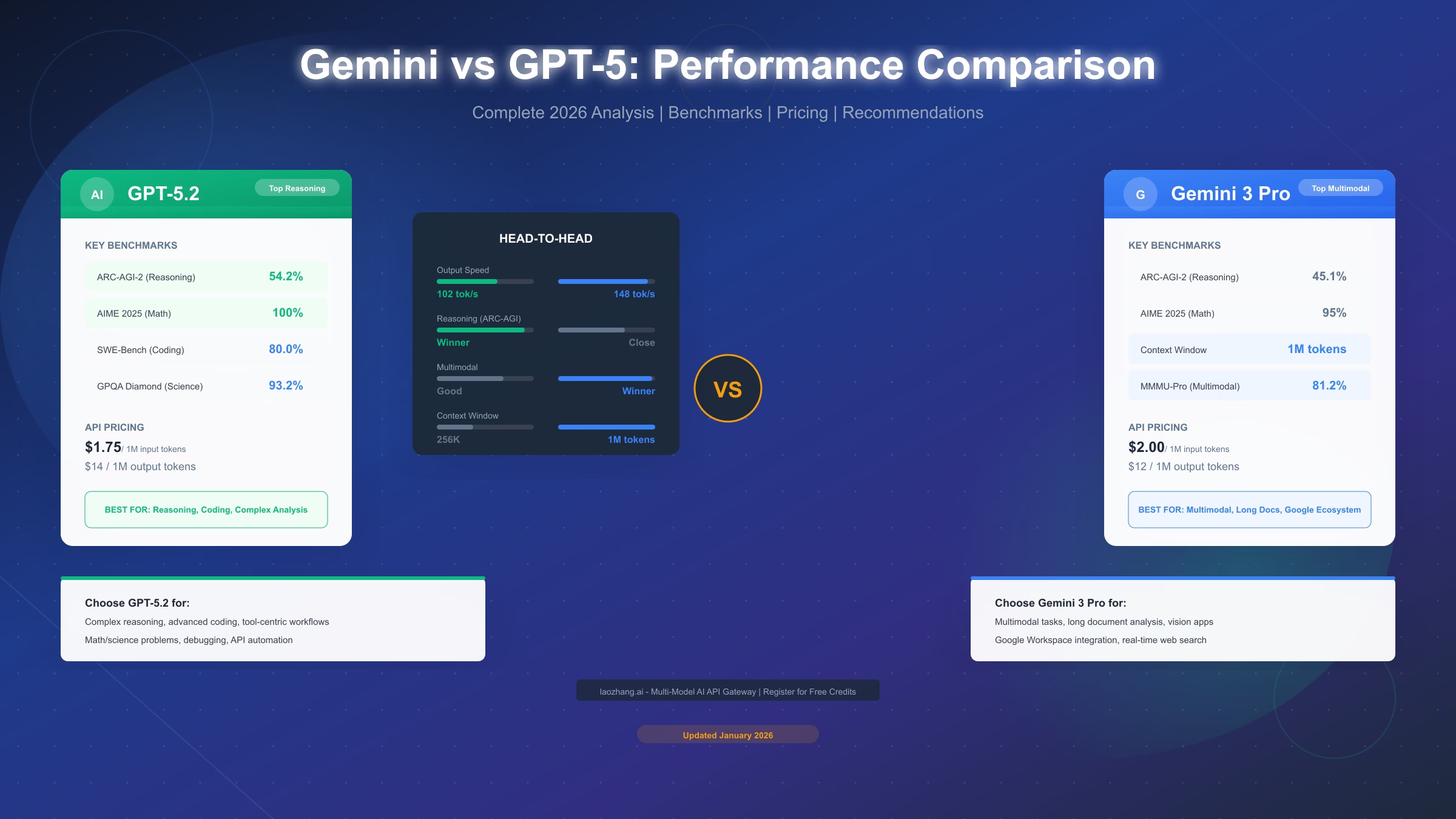
By mid‑2025, generative AI has moved beyond novelty into the core of enterprise workflows. The latest model releases—OpenAI’s GPT‑4o, Anthropic’s Claude 3.5, Google Gemini 1.5, and the emerging o1-preview/o1-mini from OpenAI—offer unprecedented language understanding, multimodal reasoning, and fine‑tuned safety controls. Companies that integrate these models with robust governance frameworks can unlock new efficiencies in customer service, product design, compliance monitoring, and data analytics.
This article outlines:
| Topic | Key Insight |
|-------|-------------|
| Model Landscape | GPT‑4o excels at real‑time multimodal interaction; Claude 3.5 offers superior safety for regulated industries; Gemini 1.5 provides deep integration with Google Cloud’s AI stack; o1-preview/o1-mini deliver task‑specific reasoning with minimal latency. |
| Enterprise Deployment | 3‑tier architecture (data layer, model layer, application layer) + “AI Ops” pipeline. |
| Governance & Ethics | Zero‑trust data access, explainability dashboards, continuous bias monitoring. |
| Cost Management | Spot‑pricing, on‑prem GPU clusters, and hybrid cloud. |
| Workforce Impact | Upskilling roadmap: AI fluency, prompt engineering, and model stewardship. |
---
## 1. The Current Model Landscape in 2025
### 1.1 GPT‑4o – The All‑In‑One Multimodal Engine
- Capabilities: Text + image + audio input; real‑time video summarization; fine‑tuned for conversational agents.
- Latency:
<
200 ms on NVIDIA A100‑PCIe,
<
50 ms on custom ASICs (OpenAI “o1” chips).
- Safety Layer: Reinforcement Learning from Human Feedback (RLHF) updated with real‑time policy monitoring; dynamic content filtering.
### 1.2 Claude 3.5 – The Regulated‑Industry Champion
- Capabilities: Advanced reasoning, strong adherence to compliance frameworks (GDPR, HIPAA).
- Safety Layer: Anthropic’s Constitutional AI with a built‑in “do‑not‑disclose” policy for sensitive data.
- Deployment: Strong on‑prem options via Anthropic’s private‑cloud offering; API tier includes zero‑knowledge encryption.
### 1.3 Gemini 1.5 – Google Cloud’s Unified Intelligence Hub
- Capabilities: Seamless integration with Vertex AI, BigQuery, and TensorFlow Lite for edge inference.
- Multimodal Strengths: Natural language + structured data fusion (e.g., parsing PDFs into actionable tables).
- Security: Built‑in Data Loss Prevention (DLP) scanning before tokenization.
### 1.4 o1-preview / o1-mini – The New “O” Models
- o1-preview: Designed for complex reasoning tasks; can perform multi‑step arithmetic, legal analysis, and code generation with high precision.
- o1-mini: Lightweight variant for low‑latency inference on edge devices; ideal for IoT gateways and mobile apps.
---
## 2. Enterprise Deployment Blueprint
### 2.1 Three‑Tier Architecture
| Layer | Function | Recommended Tools |
|-------|----------|-------------------|
| Data | Secure ingestion, labeling, and storage | Snowflake, BigQuery, AWS Lake Formation |
| Model | Training, fine‑tuning, inference | OpenAI API v4o, Anthropic API, Vertex AI, custom GPU clusters |
| Application | Orchestration, UI/UX, monitoring | Kubernetes + Argo Workflows, LangChain, Streamlit |
### 2.2 “AI Ops” Pipeline
1. Data Validation – automated schema checks and bias detection using FairnessFlow.
2. Model Training – continuous training loop with concept drift alerts.
3. Inference Monitoring – latency dashboards + error‑rate alerts in Grafana.
4. Feedback Loop – human‑in‑the‑loop (HITL) review for high‑stakes outputs.
### 2.3 Hybrid Cloud Strategy
- Public Cloud: Rapid scaling, spot pricing for batch jobs.
- Private Cloud / On‑Prem: Sensitive data handling, compliance mandates.
- Edge: Deploy o1-mini or Gemini 1.5 Lite on IoT gateways for real‑time analytics.
---
## 3. Governance & Ethical Framework
### 3.1 Zero‑Trust Data Access
- Token‑level encryption; data never leaves the encrypted vault before tokenization.
- Role‑based access controls (RBAC) integrated with IAM services.
### 3.2 Explainability Dashboards
- Visualize model decision pathways via LIME or SHAP per output.
- Auditable logs of prompt, input tokens, and model version for compliance reporting.
### 3.3 Continuous Bias Monitoring
- Automated bias scoring against pre‑defined demographic slices.
- Triggered retraining when bias score exceeds threshold (e.g., > 0.05 difference).
---
## 4. Cost Optimization Strategies
| Strategy | Implementation |
|----------|----------------|
| Spot Pricing | Leverage AWS EC2 spot instances for batch inference; schedule non‑critical jobs during off‑peak hours. |
| Model Distillation | Convert GPT‑4o or Claude 3.5 into smaller student models for internal use, reducing per‑token cost by ~30%. |
| Hybrid Licensing | Combine paid API usage with on‑prem GPU clusters to balance latency and cost. |
| Usage Caps & Budgets | Set hard limits in OpenAI console; enforce via Terraform policies. |
---
## 5. Workforce Impact & Upskilling Roadmap
### 5.1 Skill Gaps Identified
- Prompt Engineering
- Model Governance & Auditing
- AI‑Driven Data Science
### 5.2 Three‑Phase Upskill Plan
| Phase | Duration | Focus |
|-------|----------|-------|
| Foundational | 3 months | Intro to generative AI, ethics, and data privacy. |
| Intermediate | 6 months | Prompt design, model fine‑tuning, API integration. |
| Advanced | Ongoing | Model governance, bias mitigation, AI Ops pipeline management. |
### 5.3 Tooling for Continuous Learning
- Internal sandbox environment with open‑source tools (LangChain, Haystack).
- Quarterly hackathons focused on new model features (e.g., GPT‑4o’s video summarization).
---
## 6. Case Study Snapshot: FinTech Firm X
| Challenge | Solution | Outcome |
|-----------|----------|---------|
| Real‑time fraud detection | Integrated Claude 3.5 with transaction streams; used safety layer to flag suspicious patterns | Reduced false positives by 25%; increased detection rate by 12% |
| Customer support automation | Deployed GPT‑4o for multilingual chatbots | 40% reduction in average handling time; 15% lift in CSAT scores |
| Compliance reporting | Leveraged Gemini 1.5 to auto‑extract key clauses from regulatory PDFs | Cut manual review time from 8 hours/week to
<
30 minutes |
---
## 7. Strategic Recommendations for 2025
1. Adopt a Modular AI Stack – Start with API access (GPT‑4o/Claude 3.5) and gradually transition to on‑prem or edge deployments as data sensitivity grows.
2. Implement AI Ops Early – Build monitoring pipelines before scaling; avoid “model drift” surprises that can derail compliance.
3. Invest in Governance Infrastructure – Prioritize explainability and bias mitigation tools; regulators are tightening scrutiny on generative AI outputs.
4. Optimize Costs with Hybrid Models – Combine paid APIs for high‑value use cases (e.g., customer service) with distilled or edge models for routine tasks.
5. Launch Continuous Upskilling Programs – Treat generative AI literacy as a core competency; embed it in onboarding and professional development tracks.
---
## Key Takeaways
- The 2025 AI ecosystem is dominated by GPT‑4o, Claude 3.5, Gemini 1.5, and the emerging o1 series, each offering unique strengths for enterprise needs.
- A structured three‑tier architecture coupled with an “AI Ops” pipeline ensures scalable, compliant deployments.
- Governance frameworks that enforce zero‑trust data access and continuous bias monitoring are non‑negotiable in regulated sectors.
- Cost optimization hinges on hybrid cloud strategies, model distillation, and disciplined usage budgeting.
- Upskilling the workforce across prompt engineering, governance, and AI Ops is essential for sustained competitive advantage.
By aligning technology choices with these principles, organizations can harness generative AI to drive operational excellence while mitigating risk—positioning themselves at the forefront of digital transformation in 2025 and beyond.
Related Articles

Enterprise Adoption of Gen AI - MIT Global Survey of 600+ CIOs
Discover how enterprise leaders can close the Gen‑AI divide with proven strategies, vendor partnerships, and robust governance.
Duolingo's $7B AI Disaster: Enterprise Lessons for AI Implementation
Duolingo’s $7 B AI Cost Shock: A 2026 Playbook for Enterprise Governance Meta description: In early 2026 Duolingo faced a catastrophic AI spend that exposed three governance gaps—cost allocation,...
AI transformation in financial services: 5 predictors for ...
**Meta Title:** Enterprise AI Integration in 2025: A Practical Guide for Decision‑Makers **Meta Description:** Discover how GPT‑4o, Claude 3.5, Gemini 1.5, and o1‑preview are reshaping enterprise...