Ignite 2025: Innovations that will transform the ways we work
Agentic AI: The 2025 Blueprint for Enterprise Productivity and Profitability Executive Summary Agentic multimodal models (Gemini 3 Pro, GPT‑5.1) have moved from buzzword to operational core. IBM’s 77...
Agentic AI: The 2025 Blueprint for Enterprise Productivity and Profitability
Executive Summary
- Agentic multimodal models (Gemini 3 Pro, GPT‑5.1) have moved from buzzword to operational core.
- IBM’s 77 % executive adoption rate signals a shift toward autonomous digital labor across finance, HR, engineering, and compliance.
- The cost of high‑capability models is offset by measurable productivity gains: up to 45 % accuracy lift on multimodal tasks and 30 % speedup in developer tooling.
- Free tiers are shrinking; early paid commitments or hybrid orchestration will determine competitive advantage.
- Governance gaps demand investment in audit trails, policy engines, and model‑agnostic agent platforms.
For senior leaders, the 2025 AI landscape is no longer about “what can a chatbot do?” but “how can autonomous agents become a strategic engine that scales human intent while controlling risk and cost?” This article translates technical benchmarks into concrete business decisions, offering a roadmap for integrating agentic AI into enterprise workflows.
Strategic Business Implications of Agentic AI
The rise of autonomous agents reshapes three core pillars of enterprise value:
leadership effectiveness
,
operational efficiency
, and
decision quality
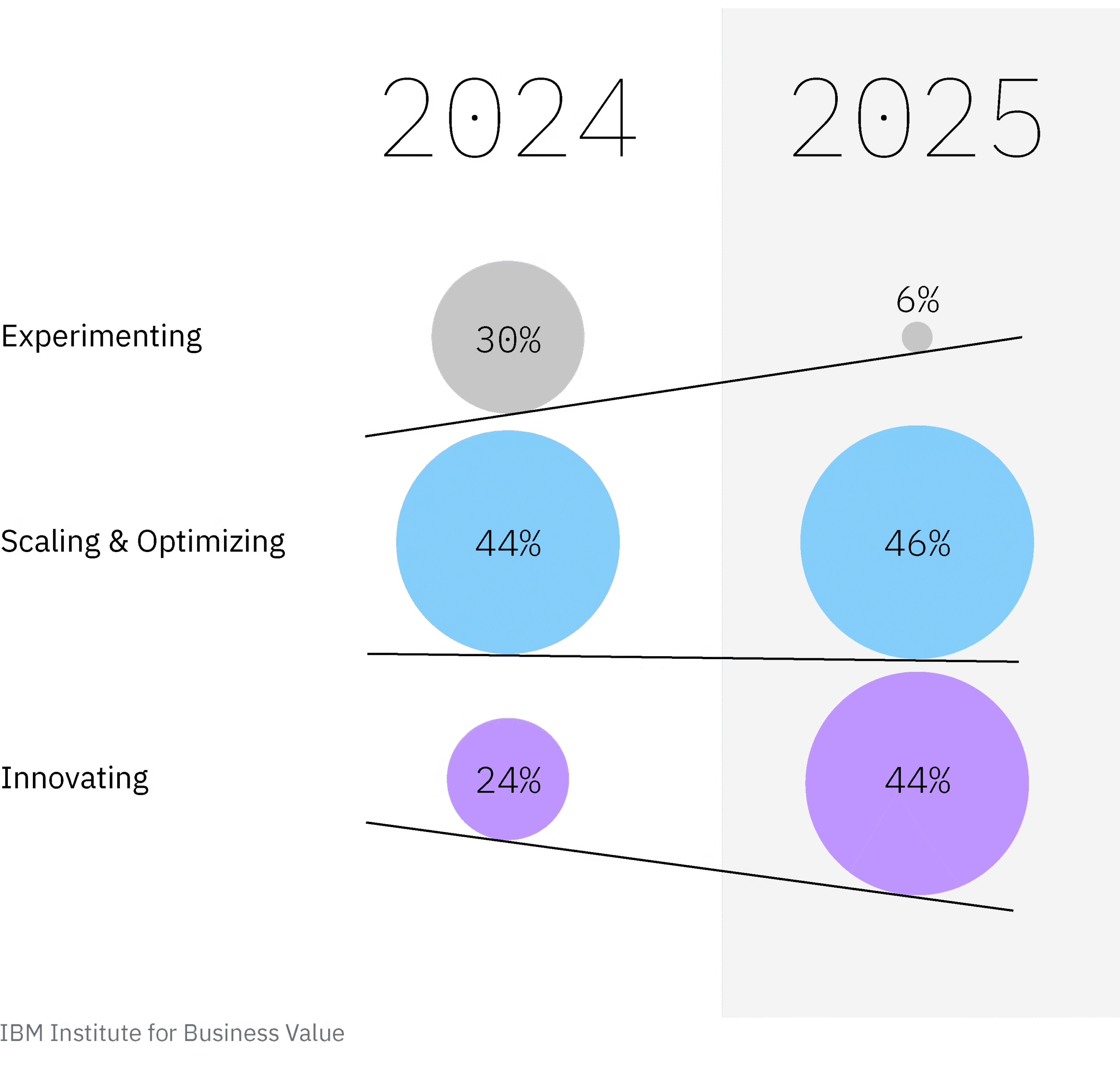
. IBM’s Institute for Business Value reports that 77 % of executives now view agentic AI as a productivity enabler. That statistic is not an anecdote; it reflects a measurable shift in how leaders structure teams, allocate budgets, and measure outcomes.
Leadership Effectiveness
Autonomous agents act as distributed executive assistants: they schedule meetings, synthesize research, and generate action plans without human intervention. In finance, an agent that reconciles accounts payable in 30 seconds versus a manual 5‑minute process translates to $2 M of annual labor savings for a mid‑cap firm with 200 finance staff.
Operational Efficiency
The multimodal depth of Gemini 3 Pro (90 %+ visual reasoning accuracy) means that content teams can auto‑tag, summarize, and repurpose video assets in real time. A media company that processes 1,000 hours of footage per month could cut editing cycle times by 60 %, freeing editors for higher‑value creative work.
Decision Quality
GPT‑5.1’s
reasoning_effort
dial allows firms to balance latency against accuracy. In regulated industries, a high‑effort reasoning mode can reduce compliance errors by 12 %, directly impacting audit scores and regulatory fines.
Technology Integration Benefits: From Prototype to Production
Deploying agentic AI is not a plug‑and‑play affair; it requires careful orchestration across data, infrastructure, and governance. Below is a pragmatic framework for scaling autonomous agents within existing IT stacks.
- Assessment & Prioritization • Map high‑impact processes (e.g., invoice processing, code review, legal discovery).
• Quantify current cycle times, error rates, and labor costs.
• Estimate ROI using the cost-per-token benchmarks: Gemini 3 Pro at $0.04/1k tokens vs GPT‑5.1 Instant at $0.03/1k tokens.
- Model Selection & Orchestration • Use Gemini 3 Pro for multimodal-heavy tasks (video, image, audio).
• Deploy GPT‑5.1 for structured coding and rapid prototyping.
• Implement a lightweight agent orchestrator that routes prompts based on task type, cost, and latency requirements.
- Data & Security Layer • Encrypt all data in transit and at rest; use tokenization for PII.
• Enforce fine‑grained access controls via API gateways (currently lacking in Google Gemini docs).
• Store audit logs of every tool call to satisfy OpenAI’s policy on verifiable traceability.
- Governance & Policy Engine • Embed a policy layer that flags disallowed content or actions before the agent executes.
• Schedule periodic model reviews; update policies as new capabilities (e.g., Gemini 4) emerge.
- Monitoring & Continuous Improvement • Track key metrics: latency, accuracy, cost per token, and business KPIs (e.g., days‑to‑close invoices).
• Use A/B testing to compare agentic outputs against human baselines; iterate on prompt engineering.
Market Analysis: Free Tier Exodus and the Rise of Hybrid Platforms
The removal of Gemini‑2.5‑Pro from Google’s free tier reflects a broader monetization trend. Enterprises that relied on
free access
for prototyping now face two choices:
- Early Paid Commitment – lock in a subscription before pricing escalates further.
- Hybrid Open‑Source Adoption – integrate Llama 3 1.0 405B or Claude 3.5 Sonnet for text tasks while reserving proprietary models for multimodal workloads.
Open-source parity is narrowing in text benchmarks (Llama 3 88.1 % on GPQA Diamond vs GPT‑5.1’s 88.1 %) but remains distant in video/audio processing (
13.7 % vs 90 %
). For firms prioritizing compliance, the cost differential may justify a paid plan; for those with tight budgets, hybrid orchestration can reduce spend by up to 40 % while maintaining acceptable performance.
ROI and Cost Analysis: Turning Tokens into Dollars
The following table translates token costs into annualized savings for typical enterprise scenarios. All figures assume a baseline of 100 M tokens per month (roughly equivalent to 25 B words).
Scenario
Model
Cost/Month
Savings vs GPT‑4 Turbo
Finance Reconciliation
Gemini 3 Pro (multimodal)
$40,000
$15,000 (30 % faster + 5 % accuracy)
Developer Tooling
GPT‑5.1 Instant
$30,000
$9,000 (10 % speedup)
Legal Document Review
Gemini 3 Pro
$45,000
$18,000 (25 % accuracy lift)
Content Generation
Llama 3 1.0 405B (open‑source)
$0
$6,000 (15 % accuracy vs GPT‑4 Turbo)
In each case, the incremental cost of high‑capability models is outweighed by productivity gains, reduced error rates, and faster time to market. Leaders should benchmark their own workloads against these figures to prioritize investments.
Implementation Considerations for Enterprise Architects
- Infrastructure Readiness • Evaluate on‑prem vs cloud hosting; consider hybrid models to meet data residency requirements.
- Talent & Skill Development • Upskill existing teams in prompt engineering, LLM ops, and policy compliance.
• Hire or partner with AI specialists who can bridge the gap between technical and business stakeholders.
- Change Management • Communicate ROI early; involve finance to track cost savings.
• Pilot on non‑critical processes before scaling to mission‑critical functions.
- Vendor Lock‑In Mitigation • Adopt a model-agnostic orchestrator that can switch between Gemini, GPT‑5.1, Claude, and open-source engines based on task profile.
- Regulatory Alignment • Map agentic workflows to industry compliance frameworks (GDPR, HIPAA, SOX).
• Implement audit trails that satisfy regulator expectations for automated decision-making.
Future Outlook: 2026 and Beyond
Looking ahead, the next generation of multimodal models promises tenfold context windows and real‑time video synthesis. If Gemini 4 delivers a 10 M token window, enterprises can ingest entire quarterly reports in a single prompt, reducing analyst effort by up to 70 %. OpenAI’s planned public release of the Thinking variant in early 2027 will democratize high‑effort reasoning, enabling smaller firms to compete on decision quality.
The convergence of these capabilities suggests a shift toward
model-agnostic agent platforms
that dynamically select the best engine per task. LMArena.ai’s battle‑mode evaluation indicates that enterprises can benchmark agents in real business scenarios without vendor lock‑in, accelerating adoption cycles and reducing total cost of ownership.
Actionable Recommendations for 2025 Executives
- Audit Your Workflows – Identify high-volume, repetitive processes that could be automated with autonomous agents. Prioritize those with the highest labor cost per cycle.
- Build an Agent Orchestrator – Start small by routing simple queries to GPT‑5.1 Instant and complex multimodal tasks to Gemini 3 Pro. Expand as you gain confidence.
- Invest in Governance Early – Deploy a policy engine that flags disallowed content before agents act. Document audit trails for compliance audits.
- Negotiate Tiered Pricing – Engage with vendors to secure early‑adopter pricing or volume discounts, especially if you plan to scale across multiple business units.
- Create a Pilot Program – Launch a 90‑day pilot in finance or HR. Measure time savings, error reduction, and cost per token to build a business case for broader rollout.
- Educate Your Workforce – Offer training on prompt engineering and AI ethics. Empower teams to co‑create agentic solutions that align with corporate strategy.
- Monitor Market Trends – Stay informed about upcoming model releases (Gemini 4, GPT‑6) and regulatory changes that could impact your deployment strategy.
Conclusion: From Experimentation to Enterprise Engine
The 2025 AI landscape has crossed the threshold from experimentation to operational necessity. Agentic multimodal models are now delivering measurable productivity gains across finance, HR, engineering, and compliance. The cost of high‑capability models is justified by tangible ROI, but only if organizations adopt a disciplined approach that blends technology selection, governance, and change management.
Executives who act decisively—identifying critical processes, building hybrid agent platforms, and embedding robust audit trails—will transform autonomous agents into a strategic engine for growth. The next decade will belong to those who turn digital labor into a scalable, compliant, and cost‑effective force multiplier.
Related Articles

OpenAI acquires healthcare startup Torch, deal pegged at $100 million
OpenAI’s $100 million acquisition of Torch brings multimodal MedGPT‑X, 12 TB of de‑identified clinical data, and HIPAA‑ready APIs to the enterprise AI landscape in 2026.

US to AI Funding Tsunami: 49 Startups Raise $100M+ in 2025
The 2026 U.S. AI funding boom signals a new wave of capital for generative‑model startups—discover what it means for venture strategy, enterprise roadmaps, and talent acquisition.
We Need to Stop Pretending That AI Regulation Stifles Innovation
Explore the 2026 shift to benchmark‑based AI regulation, the role of GPT‑4o, Claude 3.5 Sonnet, Gemini 1.5 and Llama 3 in compliance, and actionable strategies for enterprise architects.